
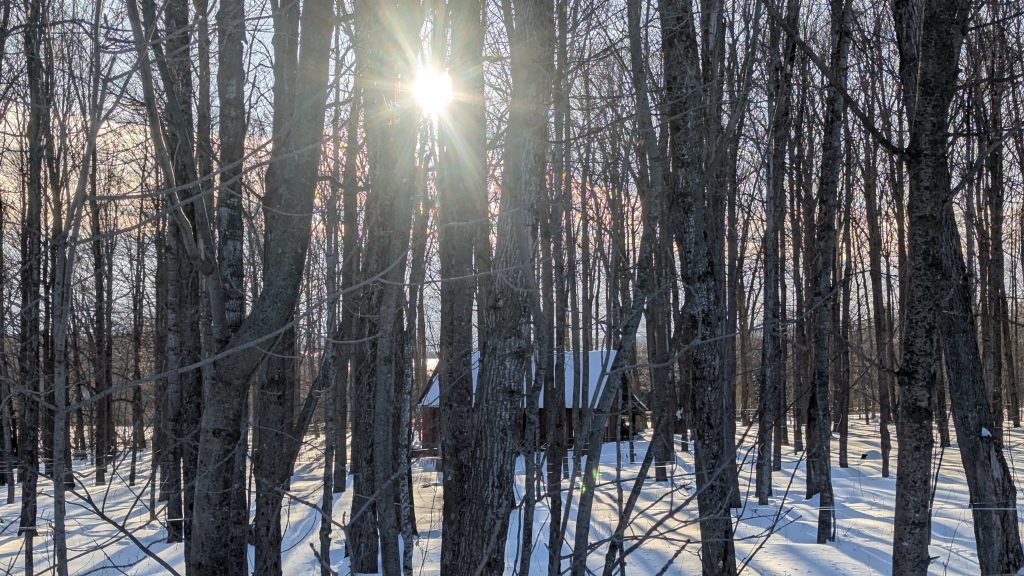
Well before the beginning of “official” spring on March 21, the rapidly warming sun climbs higher in the sky each day. As the daytime temperatures rise above the freezing point and the night returns to a deep-freeze, the maple trees begin to wake up and sugaring season is upon us!
For a few years in the early 1980s, I could not resist the temptation to try my hand at making maple syrup. I did not have a significant maple grove, but I hoped the two dozen sizable trees would do perfectly for my first experiment.
I had a collection of antique cast iron maple taps, and I selected an appropriate drill bit for my hand brace to drill the tap holes.
I had collected 24 or 25 extra large plastic margarine tubs, poked small holes just under the rim but far enough from the edge to securely support the container of sap. I fastened the plastic lids on the containers leaving a small opening for the sweet sap to drip into the tub.
On good days, I found I needed to make the rounds of my taps twice. I had two five-gallon pails secured to my sled to collect the sap.
I improvised a wood-burning evaporator, using an overturned ten gallon metal pail and a five gallon enamel canning pot. I set it up in the front vegetable garden well away from the spruce trees near the house.
I topped off the pot with clear maple sap that looked to me like plain water, and set the fire ablaze. The makeshift stove was neither large nor efficient. Even with a crooked six-foot tin stovepipe attached, it produced more smoke and fly ash than heat
Hour upon hour I fed small scraps of hardwood into the little stove. The largest piece of wood that would fit was the size of two fists placed side-by-side.
The steaming sap never actually boiled, to my knowledge, even with the blaze threatening to burn the galvanizing off the stove pipes.
As the sap reduced down over a four-day period, I was able to slowly add most of the new sap that I kept in covered plastic pails buried in a snow bank on the shady side of the barn.
By the morning of the fifth day, the contents of the pot roiled (not the same as boiled) above the still roaring flames. I dipped a long-handled spoon into the dark liquid to discover, to my surprise, that it did not appear dark simply because it was contained in a dark-blue enamel pot. The liquid had a hue not unlike molasses, although not yet the thickness of syrup. When I laid the spoon on top of the snow to let it cool, it did seem to be thicker than blood, which they claim is thicker than water.
The taste was intensely maple flavoured, balanced with overtones of hardwood smoke, nuanced echoes of spruce tannin, with fine notes of wood ash.
By that evening it had actually thickened sufficiently to legitimately be definable as “syrup.” It nearly filled a one-pint canning jar, black as coal tar, yet sweet as rock candy.
As I recall, it gave us about three meals, poured greedily over pancakes, sausages, and scrambled eggs.