
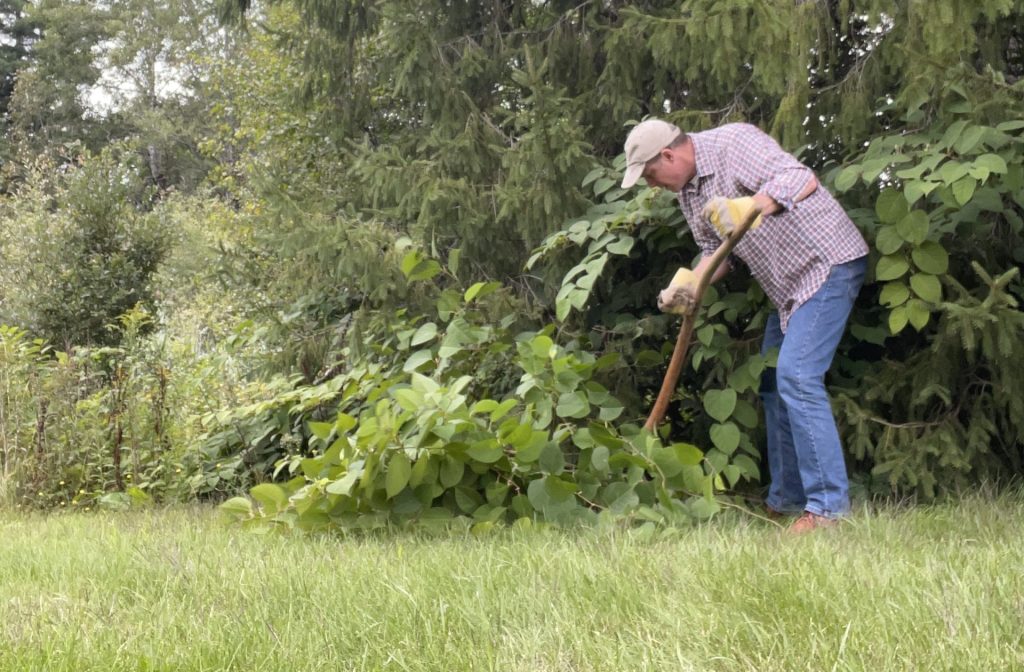
Autoportrait : Le photographe a coupé la renouée japonaise aux deux semaines pendant sept ans avant de l’éradiquer d’une partie du terrain d’un client. Les racines ont pourtant trouvé des coins plus sécures, cachées en dessous des arbres à côté, et survivent encore aujourd’hui. photo : Scott Stevenson.
They’re blossoming these days, our healthy stand of the World’s Worst Plant. They sport graceful racemes of small creamy flowers, supported by sturdy stalks 10 to 12 feet tall.
You may have already guessed I’m speaking of Japanese knotweed, aka false bamboo. Theweathernetwork.com and theknotweedlab.com both call it «the world’s worst plant.» It’s a good candidate for the plant most likely to survive the apocalypse, alongside the cockroach. It’s practically indestructible.
The previous owner of our house advised us to get rid of the small patch next to the foundation. It was trying to send shoots through the stone wall. But how to kill it?
We cut it down and heaped the branches on a compost pile. They sprouted new plants, quickly developing into a new thicket. What happened? A small fragment, just 0.02 ounces, of Japanese knotweed stem is capable of growing into a new plant, explained earth.com. It just needs a growth bud to do so, and the stems are covered with them, wherever it has a joint. Digging, mowing, or dumping soil can scatter these little pieces. In short, our earnest and well-meaning cleanup job did the opposite.
We tried—shudder—Round-up. We cut down the plants and then poured glyphosate, full strength, into the hollow stems left behind, to no effect. Neither cutting nor chemical control, nor even digging up the roots, to a depth of three feet, can eradicate it. In fact, mowing, rototilling, or composting are good ways to spread it.
Japanese knotweed has an extensive underground system of rhizomes, strong enough to rip through concrete, siding, pipes, and asphalt. It’s extremely hardy, and out-competes native plants. Dense stands of it reduce animals’ natural habitats.
In 1842 a doctor at the Dutch trading settlement in Japan brought the first live samples back to Europe, and in 1847 it won a gold medal for being the most interesting ornamental plant. By 1868 it was in North America. Today it has conquered most of Canada, including Quebec.
What to do? Will passing a law help? Let’s try, someone must have said. So now we have a regulation effective June 4 that forbids selling or cultivating Japanese knotweed and 33 other invasive exotic species across Quebec. A good, small step! But last I looked, the law has done nothing to rid our acreage of the World’s Worst.