Rachel Garber

Rachel Garber

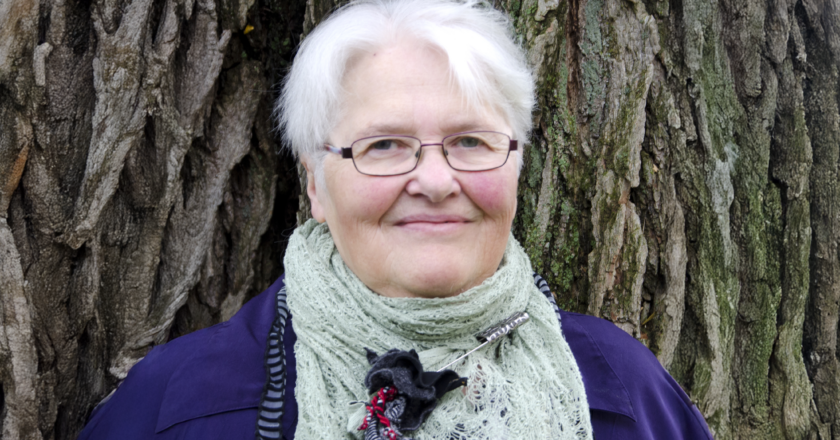
Rachel Garber writes from her home in the old hamlet of Maple Leaf, in Newport. (rawrites@gmail.com)
Rachel Garber - en-tête chroniques

Getting a grip: How to be rid of knotweed

For the past 30 years, Japanese knotweed has steadily tightened its choke hold on our land.


We used to feed its young leaves to our rabbits; they loved it. In the spring, we put leaves in our salads. Delish! Agronomist Isabelle Martineau in Abercorn makes a lemonade from young shoots; she boils it, adds lemon juice and sugar, and calls it ‘‘Renouée.’’ Tastes like rhubarb, she told CBC.


But all these uses, and even a law against its propagation, have not stopped its steady spread.

I know what doesn’t work, as I explained in my last column. Chemicals don’t work. Mowing, rototilling, and composting all spread it. Don’t be tempted to dig out the roots; they can extend more than three meters deep and seven meters away from the plant’s stem.


Now we have embarked on the long, hard war to reclaim our land for indigenous species.


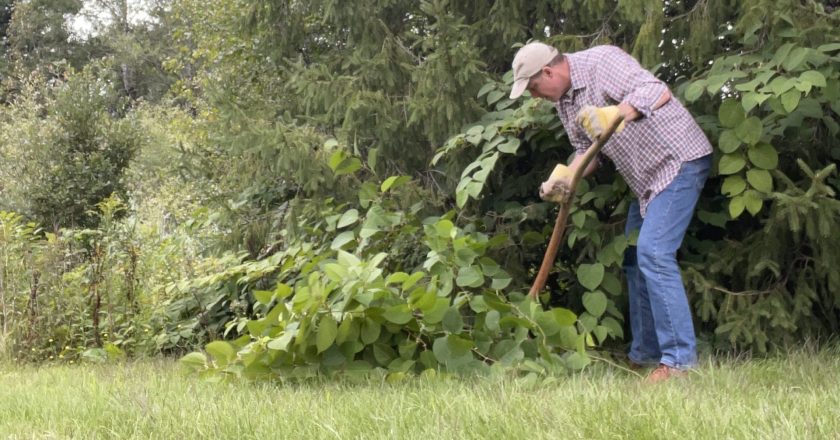
Here’s what to do: First, exhaust the energy the Japanese knotweed plant stores in its rhizomes by cutting the stems close to the ground … repeatedly, every two or three weeks during the growing season.


Next, you need to cover the whole area with a heavy-duty, opaque black geotextile membrane, also known as a tarp. Make sure the tarp extends at least two meters beyond the edges of the thicket, and weigh the edges down with rocks or logs. Leave the whole area covered for at least five years.


You’re not done yet. Clean your tools. Make sure all the dirt and debris is cleaned off your shovels, pruners, boots, and tires so you do not inadvertently transport a growth bud to another location.


What to do with the cuttings? Put all the stems, pulled-out roots, and surrounding soil into thick, sealed, black garbage bags. Dehydrate the branches by letting them sit, open, under the sun, in as much heat as possible, before closing the bags securely.
Never put Japanese knotweed in your green bin, brown bin, or home compost. It must go into an engineered technical landfill, such as that created by Valoris. Or, if you dig up soil containing roots, you can try burying it on-site at a depth of at least two meters. Yikes.


For details, see quebec.ca/agriculture-environnement-et-ressources-naturelles/flore/fiches-especes-floristiques/renouee-japon. Also, identify Japanese knotweed and other invasive species, and report them, at the Sentinel catalogue, pub.enviroweb.gouv.qc.ca/scc/Catalogue. Like I said, it’s a long, hard war.

World’s worst: Law now in effect against knotweed

Autoportrait : Le photographe a coupé la renouée japonaise aux deux semaines pendant sept ans avant de l’éradiquer d’une partie du terrain d’un client. Les racines ont pourtant trouvé des coins plus sécures, cachées en dessous des arbres à côté, et survivent encore aujourd’hui. photo : Scott Stevenson.

They’re blossoming these days, our healthy stand of the World’s Worst Plant. They sport graceful racemes of small creamy flowers, supported by sturdy stalks 10 to 12 feet tall.


You may have already guessed I’m speaking of Japanese knotweed, aka false bamboo. Theweathernetwork.com and theknotweedlab.com both call it «the world’s worst plant.» It’s a good candidate for the plant most likely to survive the apocalypse, alongside the cockroach. It’s practically indestructible.

The previous owner of our house advised us to get rid of the small patch next to the foundation. It was trying to send shoots through the stone wall. But how to kill it?


We cut it down and heaped the branches on a compost pile. They sprouted new plants, quickly developing into a new thicket. What happened? A small fragment, just 0.02 ounces, of Japanese knotweed stem is capable of growing into a new plant, explained earth.com. It just needs a growth bud to do so, and the stems are covered with them, wherever it has a joint. Digging, mowing, or dumping soil can scatter these little pieces. In short, our earnest and well-meaning cleanup job did the opposite.

We tried—shudder—Round-up. We cut down the plants and then poured glyphosate, full strength, into the hollow stems left behind, to no effect. Neither cutting nor chemical control, nor even digging up the roots, to a depth of three feet, can eradicate it. In fact, mowing, rototilling, or composting are good ways to spread it.


Japanese knotweed has an extensive underground system of rhizomes, strong enough to rip through concrete, siding, pipes, and asphalt. It’s extremely hardy, and out-competes native plants. Dense stands of it reduce animals’ natural habitats.


In 1842 a doctor at the Dutch trading settlement in Japan brought the first live samples back to Europe, and in 1847 it won a gold medal for being the most interesting ornamental plant. By 1868 it was in North America. Today it has conquered most of Canada, including Quebec.


What to do? Will passing a law help? Let’s try, someone must have said. So now we have a regulation effective June 4 that forbids selling or cultivating Japanese knotweed and 33 other invasive exotic species across Quebec. A good, small step! But last I looked, the law has done nothing to rid our acreage of the World’s Worst.

Rachel Garber - en-tête chroniques

30 Years

It’s been 30 years since I arrived in the Haut-Saint-François. Hot and tired, we led the moving van up the hill. Beside our home-to-be, the stand of black locust trees (aka false acacia) was in glorious bloom. It was Montreal’s moving day, July 1st.
For years, this fine, fragrant happening returned July 1st on the dot, until it came gradually earlier and earlier. Now it comes mid-June.


One morning in those early years, a small tornado whipped up our hill. It twisted the tops off some of our black locust trees, yet the wood was so tough the branches would not relinquish their grasp. They are too high to cut off, so still hang to this day, anchored forever to the trunk. The tornado ripped up another tree by the roots. The roots fought back, sending up hundreds of shoots.


They’re trash trees, the previous owner said about our black locust trees. The wood is good for nothing. The grain is too twisted and doesn’t burn well. They have thorns. But the blossoms smell nice.


I’m sorry it took me so long to fact-check him.


Yes, the blossoms smell sweet. I can easily believe their honey is highly prized, by both bees and humans. But I found out more about this Robinia pseudoacacia from various sources; a personable one is Ryan Davis in «Tree Talk: Black Locust» on YouTube.
The trash talk or «weedy» label likely stems from how quickly it grows, how sharp are its thorns, and how opportunistically it grows in areas after a fire or other disturbance has cleared the forest cover. It likes light. Yet it is not invasive; it is native to eastern North America.


As I saw in action, the wood is superbly strong and rot-resistant, so prized for fence posts. Like iron. It’s also gnarled. «I love turning bowls with this wood,» wrote a woodworker.


Two mysteries: those sharp things are spines, not thorns (wnps.org). Also, shine a UV (black) light on the cut wood, and it fluoresces yellow green.


Another surprise: In a wood stove, it makes some of the hottest fires of any kind of wood, 26.7 million BTUs per cord. Good for those cold, harsh days in January and February, says wood-heating-solutions.com.


In my 30th winter here, I’ll think of that, should our heat pumps fail us. I’ll dream fluorescent yellow-green fires.

Remembering Janis Graham

Janis Graham at the piano in 2012. PHOTO: R.A. Garber.

An exceptional person left us last week, with piano music playing softly in the distance. Janis Graham and her famous musical talent left so many good memories with us. Our sympathies to her family.


I met Jan long ago. In 1996, my family was “house poor,” and began frequenting estate auctions to find good bargains. (There were so many auctions in those days!) That’s how we got to appreciate the silver tongues of her auctioneer husband, Harry Graham, Jr., and then her son, Scott.


But I always felt the power behind the throne was Jan. She seemed to be everywhere, making sure things ran smoothly. And when a piano came up for sale, she would sit down with a flourish and play, showing off the instrument to extravagant advantage.
Then when I began writing this column, I learned how vital her music was for community gatherings. So many of them depended on Jan Graham playing piano, whether old-time music for Old Fashioned Day at the Eaton Corner Museum, intermission music for a community play, or dance tunes at the Sawyerville Hotel.


A musical revue on October 24, 2014, at the Bulwer Community Centre honouring “our veterans and war brides” featured Jan Graham on piano along with Peter Mackey of Waterville and David McBurney of Sawyerville on guitars, and singers Paulette Haseltine of Moe’s River, Marlene Lowry of Sawyerville, and World War II Veteran Grant Taylor singing “White Cliffs of Dover.”
At the 150th anniversary of the Sawyerville Hotel in September 2014, I reported in the Journal, “Graham played an 1894 Wentworth piano from Boston.”


Those were the days! Her playing was fluent, by ear. Atop the piano was usually a small stack of her CDs for sale. The community, her community, rode high on her notes.


In 2014, I had occasion to consult her about a mystery photo discovered in the Sawyerville Hotel. “That’s Uncle Frank!” she said, “the ox driver”; actually, her great-uncle Frank Greenlay, in-law – her husband’s mother’s father’s brother. He owned the Greenlay Block in downtown Sawyerville, where the post office now stands.


Thank you for your generous gift, Jan, your gift of community.

R.A. Garber

Rachel Garber - en-tête chroniques

Exceptional municipalities

by R.A. Garber

Exceptional people walk among us.


I’m referring to the citizens of the 91 municipalities (or boroughs within cities) in Quebec which have bilingual status. Among these are 16 in the Eastern Townships, including two in the Haut-Saint-François. They are Bury and Newport.


The Office de la langue française website (oqlf.gouv.qc.ca) lists these exceptional municipalities. It’s legal.
In 2022, the Quebec government’s Bill 96 proposed to revoke this status for municipalities where fewer than 50 percent of the citizens had English as a mother tongue, unless the municipal council passed a resolution to the contrary. Very quickly, all the municipalities in question passed resolutions to conserve their right to provide services in both French and English.


My hat is off to those councils and the citizens who supported them in this decision. I appreciate their willingness to serve their mostly aging English-speaking population in English. Could it be that these municipal governments felt capable of deciding how to best serve their citizens, and wished to continue doing so?


So a few weeks ago, many Lennoxville citizens were puzzled about the borough’s new directive to carry out a verbal verification of their eligibility before serving someone in English. Within the City of Sherbrooke, the Borough of Lennoxville has bilingual status.


Now we have clarification: The Bill 14 language directive stipulating who may be served in a language other than French does not apply to municipalities with legal bilingual status. The City of Sherbrooke told news media that, because of its bilingual status, the Borough of Lennoxville will not be required to conduct verbal verification of citizens to be served in English. (The City is to table a corrected directive for Lennoxville at its council meeting on July 7.)


This also applies to our two municipalities with bilingual status, Bury and Newport.


But not to the 12 municipalities in our MRC without bilingual status: Ascot Corner, Cookshire-Eaton, Chartierville, Dudswell, East Angus, Hampton, La Patrie, Lingwick, Saint-Isidore-de-Clifton, Scotstown, Weedon, and Westbury. There, under the new law, English speakers can expect to be asked – scout’s honour – if they meet one of the eligibility criteria to receive services in a language other than French. (The June 17th Rachel Writes lists these criteria).


Truth be told, there’s nowhere on earth I am not a minority, an exception. So I fit nicely, I think, in the exceptional municipality of Newport.

Rachel Garber - en-tête chroniques

CHRONIQUE | A dance we know

It’s been in the news lately, the recent update to Bill 101, the French Language Charter. I wondered how it will affect services offered by our two municipalities with legal bilingual status, so I questioned the mayors of Bury and Newport.


“Has your municipality formulated directives about communicating with citizens in French? Do you plan to ask citizens to attest that they are eligible for services in English, per Bill 14?”


The new law says all services must be in French, with a few exceptions. First, you attest you always received services in English before May 13, 2021. Or you have an eligibility certificate to attend school in English. You can also receive services in English if you immigrated to Quebec within the last six months, or you are an Indigenous person.


This directive has caused a kerfuffle in the news recently regarding Lennoxville, the only borough of Sherbrooke to have bilingual status.


Putting it politely, Mayor Denis Savage of Bury and Mayor Robert Asselin of Newport both received my questions with consternation. I’d say both are proud of the official bilingual status of their small municipalities.


When this status was under threat three years ago, the councils of both municipalities voted unanimously to retain it. I interviewed the mayors then. I recall their expressions of community, historical awareness, and respect.


The law is an ass, it’s been said. That sounds rude, but in fact it simply points out that laws, in general, express an ideal or ideology that cannot account for the multitude of exceptions to the rule one encounters in real life. Blindly and strictly following the letter of the law may well lead to an unfair or absurd outcome rather than true justice.


So how does Bill 14 work in the context of a municipality with legal bilingual status? Which law has primacy?
What happens in real life? It’s a dance we all know, where French and English speakers negotiate their limits of expression and understanding in both languages, sometimes congenially expanding those limits.


As Mayor Asselin noted, French-speaking employees cannot legally be required to speak English. But both mayors remarked that French-speaking municipal personnel and English-speaking citizens manage to communicate together. Both municipalities publish bilingual newsletters. Neither has a plan to quiz citizens about their eligibility to receive services in English.


That just seems like common sense.

Rachel writes from Newport.

Rachel Garber - en-tête chroniques

CHRONIQUE | Tiny things

Beside the woodpile, I sat down on a log for a little break. Yes, I was wearing pants and boots.


But when I undressed later, imagine my shock to discover a tick clinging to my thigh.


Sometimes the tiniest things deliver the biggest wallop.


When that blacklegged tick bites you or an animal you love, for example, it can transmit a bacteria named borrelia burgdorferi. That delivers Lyme disease, the most common among five different tick-borne diseases identified in Quebec. Read all about it at quebec.ca/health/health-issues or canada.ca/en/public-health.

Our Estrie region is one of the riskiest in Canada, no doubt because of our rural environment. And we’re smack-dab against the U.S., whence the tick hails, transmitting Lyme disease along its way. That disease was first identified in 1977 in Lyme, Connecticut, after an outbreak of arthritis in children.


Forget the YouTube conspiracies about ticks being deliberately implanted in our region (‘‘ an empty box was discovered…’’). It’s a simple fact that as our climate has been warming over the past decades, our environment has been inviting them northward.


Online platforms that track the presence of ticks (etick.ca or exterminatek.ca) tell us we have a massive spike in ticks this year. Early-season tick reports are up by almost 70%. (I am shocked to see three tick-sightings by people in my very own neighbourhood.)


Where to look for them? In wooded areas, but also in tall grass, brush, woodpiles, piles of leaves, and gardens.
If you have blood, they will be looking for you. But you may not notice their bite because they are so tiny, and their bite is usually painless. In early summer, in their nymph stage, they are the size of a poppy seed; in the fall, adults are the size of a sesame seed. After feeding, they balloon up with your blood.

What to do? Remove them as soon as possible, but do it the smart way: With clean fine-pointed tweezers, grasp the head as close to the skin as possible and pull straight out. Canada.ca/en/public-health/services offers blow-by-blow instructions. But first, keep those tweezers handy. The sooner you extract the tick, the better your chances to escape Lyme disease.


So check your skin for them. Speaking of small things, don’t forget to check your belly button and other sheltered spots on your body. That’s where a tick could be hanging out.

Rachel writes from Newport.

Rachel Garber - en-tête chroniques

CHRONIQUE | My bin of plastics

My recycling bin is filling up fast these days. With plastic. No matter what I buy, it seems to come swathed in plastic. Broccoli. Carrots. Lettuce. Bottles of dishwashing liquid, too, are bundled into a plastic bag that I’m not really sure is recyclable.


More than ever, I feel as if plastic wrappings are being thrust on me. Despite using fabric reusable shopping bags, way too much one-use-only plastic comes home with me.


Plastic manufacturers say they’re responding to customer demand, but really, when I demand fresh fruit and vegetables, I am not asking for the plastic bags they come in. I just want the contents. I’d be happy to supply my own containers.


So when I heard Beth Gardiner interviewed on CBC the other week, I listened up. She’s the author of a new book, Plastic Inc., that lays out what’s behind the plastic pandemic. She pointed out that plastics are a product of the oil industry. Leaders of these giant corporations have been very open about feeling under threat by a reduced demand for fossil fuels.


Our reliance on oil has grown expensive, and risky. People are opting for renewable energy and electric vehicles, especially in the context of the US-Iran war and the Strait of Hormuz bottleneck. So, say leaders of the oil industries, their strategy is to, instead, push plastics on consumers. Indeed, plastic, too, is a petroleum product.


That’s the context for the grand effort to recycle plastic. Gardiner noted that it’s hard for recycled plastic to compete economically with virgin plastic. Also, for the recycling process to be viable, the plastic has to be well sorted. If different kinds of plastics are thrown in together, it makes recycling harder. Too much goes into the landfill.


And who’s laughing their way to the bank? Who but the companies who have created the problem. While local municipalities and citizens foot the bill for recycling.


Here Gardiner proposed a strategy I could go for: The world needs to shift the burden for disposing of used plastic back onto the producers of plastic. It’s called «extended producers’ responsibilities,» a law to force plastic producers to deal with recycling.


Plastic Inc. has been compared to Rachel Carson’s The Silent Spring (1962), which rang alarm bells about how pesticides such as DDT damage nature. Many say it launched the modern environmental movement.


May Gardiner’s book do the same, about plastics!

Rachel writes from Newport.

Rachel Garber - en-tête chroniques

CHRONIQUE | My Mother

My mother was a gifted person who struggled to follow the Apostle Paul’s admonitions. How often I heard this verse:


Let your women keep silence in the churches: for it is not permitted unto them to speak; but they are commanded to be under obedience as also saith the law. And if they will learn any thing, let them ask their husbands at home: for it is a shame for women to speak in the church (I Corinthians 14:34-35).
Within her holy prison, my mother made a place for herself as the pastor’s wife. She led the singing in church on Sundays, choosing hymns that harmonized with the sermon. When the time came to lead a song, she would stand, announce the page number of the hymn, and its title. She’d raise her right hand to beat time, take a deep breath, and lead the singing in her assured, melodic voice.
One Sunday, she decided obedience to scripture dictated a change. In the car going to church, she told my father that because women were not to speak in church, she could no longer announce the hymns. He would have to do it.


He protested.


She was silent.


The showdown came during the service.


“Now we will have our first hymn,” my father announced, and sat down behind the pulpit.
But instead of rising as she usually did, my mother remained seated on the front bench.
“You announce the hymn,” she mouthed silently to him.


“No, you do it,” he mouthed back.
Congregation members craned their necks, straining to understand the silent argument. The impasse was prolonged and intense.


At last, face flushed, my father stood up again. His shoulders slumped. His eyes locked down on his church bulletin lying on the pulpit.


“Please open your hymnal to page 451.”
On the ride home after church, he berated her in a harsh voice. She should have obeyed him.
My mother wept silently.


But she had made her point. If she should not speak, she would not. Her obedience to the letter of the law rhymed, in its ferocity, with her inner rebellion.


Here we come to the Mother’s Day gift I would love to give my mother, were she alive: To have her own voice, and be heard with respect.

Rachel writes from Newport.

Étoile DUO : Accompagner nos jeunes mères 

L’équipe de l’Étoile DUO (de gauche à droite), Crystel Labrie-Proulx, Erika Blouin, Catherine Meilleur, Amy Poirier, Karine Archambault, Léane Hébert, Léonie Bourque, Bruno Lachance et Rachel Miron. Apparaissent également les deux bénévoles canins de l’équipe, Albert et Gaïa. PHOTO : Bianka Gelé Dupuis.

« Être parent n’est pas facile », a commenté Rachel Miron, directrice générale de l’organisme à but non lucratif Étoile DUO. « En cette fête des Mères, je souhaite à toutes nos mamans de trouver de la douceur, d’avoir du temps pour elles-mêmes, et de pouvoir compter sur quelqu’un qui prenne soin d’elles et qui reconnaisse leurs efforts. »


Étoile DUO a son siège social au centre-ville de Cookshire, mais ses intervenantes sont présentes dans toute la MRC du Haut-Saint-François (HSF), offrant une assistance aux jeunes mères à domicile avant, pendant et après l’accouchement.


Avec une superficie de plus de 2 300 kilomètres carrés, notre MRC est la deuxième plus grande de la région de l’Estrie. Les infirmières, les intervenantes psychosociales et les chiens bénévoles de l’Étoile, Albert et Gaïa, se rendent partout où une mère et son bébé ont besoin d’eux. La Dre Marie-Ève Bélanger, du Groupe de médecine de famille (GMF) du HSF à Cookshire-Eaton, assure la supervision clinique des membres de l’équipe.


Mme Miron a indiqué que les services d’Étoile DUO sont très sollicités. Le Haut est une région « économiquement vulnérable », avec des taux d’alphabétisation et de revenus inférieurs à la moyenne. Cela signifie que les jeunes parents ne sont pas toujours en mesure de parcourir les distances nécessaires pour obtenir une aide médicale ou psychosociale.


« Parfois, il s’agit de choisir entre faire le plein d’essence et mettre du pain sur la table. »
Quelque 210 bébés naissent chaque année dans la MRC, a-t-elle déclaré. « Du 31 mars 2025 au 1er avril 2026, nous avons rencontré 85 familles, pour un total de 3 952 interventions, » a indiqué Mme Miron. « Aussi, 71 enfants entre 0-5 ans ont bénéficié de services infirmiers, soit à domicile ou au GMF. Nous avons effectué 40 suivis de grossesse et 684 suivis psychosociaux auprès d’un parent, soit à domicile ou au GMF. »


L’Étoile DUO est un organisme relativement récent, offrant ses services depuis 2023. L’équipe reçoit des demandes de ses partenaires, notamment le GMF du Haut-Saint-François à Cookshire-Eaton, Moisson du Haut-Saint-François et le CLSC. Le site Web etoileduo.ca répertorie plus de 20 services offerts gratuitement dans les domaines du développement de l’enfant, des soins infirmiers et du suivi psychologique.


« Nous sommes une petite équipe, a déclaré Mme Miron, pour un territoire aussi vaste. »
Un autre défi, a-t-elle expliqué, est que l’Étoile DUO est financé par le ministère de la Santé et des Services sociaux (MSSS), mais que ce soutien n’est pas garanti d’une année à l’autre. « On n’a pas de bailleur de fonds. Nous sommes très reconnaissants envers le MSSS, mais si un jour ce soutien venait à cesser, nous devrions fermer nos portes. »


« L’une des choses que nous aimerions vraiment mettre en place, c’est une clinique mobile, dans une mini-fourgonnette avec une infirmière et un autre intervenant. Si seulement nous avions le soutien financier nécessaire », a-t-elle conclu.

Rachel Garber - en-tête chroniques

OPINION | Rewilding Our Hens

Our new young hens were shocked to see little green shoots emerging from the blanket of brown leaves in the back yard. Not just grass. Clover. Dandelions and fawn lilies. Oh yes, Japanese knotweed, too, delicious when it’s small and tender.


Scratch a bit here, peck a bit there, discuss it with a friend. It was fun to watch their curiosity turn to glee.


Turns out we’ve been «rewilding» our four acres over the past 30 years. Not that we knew what to call it; we just wanted nature around us. So we planted trees, as many different kinds as possible, bushes and other plants.


Then about five years ago, we joined the no-mow-May movement, to give bees and other pollinators a source of food at a time when flowers are scarce. (Yes, dandelions are flowers, too!)
Then we learned about rewilding, and discovered we really don’t need to create a green desert lawn in any of the other months, either.


Yes, I’m talking deserts. There’s a whole movement of people aiming to remedy the monoculture lawns of the 1950s, with their artificial fertilizer, weedkillers, and mowing. They mean to rescue nature, one yard at a time, urban and rural. Cemeteries, too, or balconies and window boxes.


In a TED Talk last summer, Isabella Tree gave three tips to re-wild your yard. First, she said, the earth is not flat; lumps and bumps provide sun and shade for small animals. We’ve built a few small hills by piling up compost or old branches. Or you could build a bump by mixing old building materials with sand, and covering it with compost.


Second, think like a herbivore. If you mow, be a cow; nibble here and there, and leave some areas long. Mix it up. Variety is natural. If you have an invasive species crowding out everything else, be a wild bore and root it out.


Third, Ms. Tree said, find life in death. Leave dead trees, branches and old leaves lie around. They provide habitat for small animals and natural fertilizer for next year, and the seed-heads are food for winter birds.


In short, she said, think of yourself as a «keystone species» whose job is to restore your ecosystem. It’s the least we can do.


«It’s more than romance. It’s science,» I tell our hens. They pay no mind. They’re too busy rewilding themselves.


Rachel writes from Newport.

SANTÉ | Les bienfaits du bain de forêt

Aujourd’hui, c’est le Jour de la Terre, une journée où l’on réfléchit généralement à ce que l’on peut faire pour l’environnement. Adoptons un autre point de vue : que peut faire la nature pour nous ?
Bien des choses, en fait. De plus en plus de recherches menées au cours de la dernière décennie indiquent que le contact avec la nature peut favoriser la santé physique et mentale. Selon le programme « Santé mentale verdoyante » du CIUSSS-Estrie, 9 Canadiens sur 10 se disent plus heureux après avoir passé du temps en nature. Même un bref moment passé en plein air peut constituer un remède efficace contre le stress intense et l’exposition excessive aux écrans dans notre quotidien.


En effet, seulement 20 minutes par jour, ou deux heures par semaine, peuvent mener à des résultats tangibles : réduction de l’anxiété et des émotions négatives, et amélioration de la confiance en soi, du bien-être et du rythme cardiaque. Un chercheur a rapporté que le fait d’être entouré de 10 arbres peut améliorer le sentiment de bien-être autant que recevoir 10 000 $ de plus par an, ou avoir sept ans en moins.

Le guide de « Santé mentale verdoyante » présente quatre façons de se rapprocher de la nature. L’immersion aventureuse consiste en une activité physique en plein air, comme la marche, le yoga, le vélo, le camping ou les sports d’hiver. L’immersion simple est moins exigeante : lecture, pique-nique, dessin, photographie, ou observation des étoiles.


L’exposition quasi-passive comprend pour sa part l’observation des oiseaux depuis sa terrasse, le jardinage, la culture d’herbes aromatiques ou la visite d’une cabane à sucre. Quant à l’exposition simple, il s’agit simplement de s’exposer à la lumière naturelle, d’écouter les sons de la nature, de regarder par la fenêtre ou un tableau dépeignant un paysage, de lire un livre sur la nature, de regarder un documentaire sur la nature, ou même, croyez-le ou non, d’avoir des images de nature comme fond d’écran.


Ces deux dernières méthodes sont très similaires au « bain de forêt » (ou médecine forestière, shinrin-yoku), une pratique japonaise qui consiste à faire de promenades lentes et conscientes en forêt, en mobilisant les cinq sens. En flânant sans but précis, on hume le parfum des arbres, on écoute le chant des oiseaux, et on touche les feuilles. L’idée est d’être attentif et contemplatif, comme pour la méditation. En 1982, le bain de forêt a été intégré au programme national de santé publique du Japon, selon globalwellnessinstitute.org.


La bonne nouvelle, c’est que la nature est abondante et généreuse ici, dans le Haut-Saint-François, pourvu qu’on en prenne soin ! Certains professionnels de la santé mentale prescrivent désormais l’exposition à la nature (une « ordonnance de parc »), indique l’Association canadienne de psychologie. Mais après tout, c’est quelque chose que nous pouvons nous prescrire nous-mêmes !

Rachel Garber - en-tête chroniques

OPINION | Lucky or unlucky?

Once there was an old Zen farmer whose car was a gas-guzzling rattletrap. One day it broke down.
“Such bad luck!” his neighbour said.


“Good luck? Bad luck? Who knows?” he replied.
His neighbour was a little confused, but soon, with the help of a government subsidy, the farmer was able to buy an electric car.


“How lucky you are!”
“Lucky or unlucky, who knows?” He shrugged.
Some months later, electricity became more scarce and more expensive as people resorted to heat pumps and other electric heating. The farmer struggled to make ends meet.
“Such bad luck!” his wife lamented.


The farmer just shrugged again. “Bad or good, who knows?”
His wife consoled herself by thinking about the good they were doing for the environment by forsaking fossil fuels and having a car whose electrical wiring had soy-based coverings rather than plastic.
“So that’s good!” she said.


“Good or bad, who knows?” came the farmer’s reply.
One day as they pulled off the highway and stopped at a traffic light, the car suddenly went dead.
The farmer’s neighbours thought it very unlucky, but his wife felt lucky it had not happened while they were speeding on the highway. The farmer said nothing.


They soon got a call from the serviceman. “Unluckily, mice have chewed many of the wires leading into the fuse box. They love the soy-based covering. Replacing the unit will cost thousands of dollars. But luckily, this is not an unusual problem, and your insurance policy should cover it.”
“How lucky!” the farmer’s wife commented.
“Who knows?” said the farmer.


The insurance adjuster insisted on replacing only the damaged wires rather than the whole unit. But the dealer refused this, saying repairing all 1000 wires was not possible, and he could not be responsible if an accident happened again. Caught between them, the farmer finally got their car back three months later, with the fuse box replaced, by paying the $1,500 the insurance company had refused to pay.
“What bad luck!” said his wife.


“Good or bad, who knows?”
Finally, a new broker found them a new policy with another insurance company, offering equivalent coverage at almost $1000 less per year. And soon after that, an ill-conceived war closed the Strait of Hormuz, and gas prices shot sky high.
“Amazing! We are so fortunate!” said his wife.
Well, by now you know the Zen farmer’s response…

Rachel writes from Newport.

Rachel Garber - en-tête chroniques

Parking lotrip-off

Ipromise you, this is the last installment of our cross-border adventures! Listen in on my letter asking for justice.


Mr. Chirag Patel, General Manager, Hampton Inn By Hilton, Owego, New York
Dear Mr. Patel:

Congratulations on the 10th anniversary of Hampton Inn Owego! I was heartened to see Lindsay Arons’ tribute to you in the March 2026 Business Spotlight by WIVT and WBGH, because it makes me confident you will want to remedy a problem in your services.


As I was preparing my income tax papers, I discovered a mystifying charge of $36.15 USD ($52.31 Canadian) from «Nayax Vending» on my credit card bill.


It immediately followed a charge of $25.13 USD ($36.20 Canadian) from «Nayax EV Vehicle C.» Both charges were incurred November 27, when we recharged our Ionic 5 electric vehicle at the EV Gateway charging station in the Hampton Inn, Owego, New York, parking lot at 5:36 p.m.


A quick online search identified Nayax as offering «payment solutions» for vending and other unattended machines, such as electric vehicle charging machines.


You can see our car in the attached photo (the flower on top clearly identifies it as ours), and I am sure you will recognize your parking lot and charging stations. This very photo, taken by John Mackley on November 27, is visible to the world on ChargeHub, where he regularly lists reviews of charging stations.


At $25.15 USD, we found the cost of charging at your station rather hefty; electricity is so much cheaper here in Quebec! Nonetheless, as passers-by, we were very grateful for your service.
However, the separate charge of $36.15 by «Nayax Vending» is obviously in error. Because Nayax only offers refunds to the «operators» of their machines, and not directly to customers, we are asking you, Mr. Patel, for justice.


Mr. Patel, we were grateful to have found your high-speed electric charging stations. We often have to search for them hidden in the far reaches of a concrete desert, so we were also grateful for the restaurants and other amenities nearby, which Mr. Arons attributes to your interventions for «welcoming visitors, business travellers and families to Tioga County.»
Could the Hampton Inn by Hilton Owega please refund our $36.15 USD?
We are confidently looking forward to your response.

Rachel writes from Newport.

Rachel Garber - en-tête chroniques

Apple across the border

Returning home from the belly of the beast, we got a bit careless. After all, we’re Canadians at a Canada border crossing. And we were tired, very tired, from fighting our way through a snowy landscape.


“Do you have anything to declare?”
“No.”
“Do you have any fresh fruit or vegetables?”
“No.”
“Did you buy or receive anything?”
“No.”
And so on. The litany of questions was so predictable, my “no … no … no … no” came perhaps a bit too quickly.
The agent told us to pull into the parking area at the side, turn off our car, leave the key in it, and go sit in the building beyond.
Going through our car, the agents took their time, it seemed. But then they had a lot to go through. We had been visiting family for a good two weeks.


Used books cost what these days? It’s hard to even give them away.
My siblings sluff off as many books as they can into my hands. I wondered idly if I should have mentioned the complete set of Louise Penny’s Gamache series that my brother had thrust upon me as we were leaving his house.


Knowing he had read one of Penny’s books, his best beloved had given the set to him shortly before she died. Alas, he could not stomach reading them.


The agents came to see us inside the building.
“Did you go to a Louise Penny event while you were in the U.S.?”
“No. They’re my brother’s books. He lent them to me. They’re used.”


We had not behaved well, they said. A loan versus a gift is an arguable point; we should have declared the books. Why, half of them were even in their original plastic package, unopened!
I was too tired to argue. I didn’t even think to protest that Louise Penny is from the Eastern Townships, ergo Canada. The books are Canadian content, after all. And Louise had famously foregone touring in the U.S. for her latest book. How could they charge duty on books that had originated in Canada?
Maybe being old and tired saved the day, because they let us go. They did not even search my handbag, wherein a forbidden apple lay forgotten.


Is that how it works, using a war to distract attention from a secret evil?

Tyrants beware

“John Mitchell, Jr., Fighting Editor.”
In Richmond’s Black History Museum and Cultural Centre, the metal plaque catches my eye. It looks like it has been ripped off a street-side signpost.


“Born enslaved near Richmond [Virginia] in 1863, John Mitchell, Jr., came of age in the tumultuous post-Civil War era,” the text begins. “In 1883, he launched a daring journalism career, becoming editor and publisher of the black-owned Richmond Planet, once located near here. Known as the ‘Fighting Editor,’ Mitchell crusaded against lynching.”


He spearheaded a boycott against segregated streetcars. He ran for governor in a fight for voting rights. And more. He persevered as editor until his death in 1929.


How interesting, I think, that the sign is topped by an insignia showing a spear-wielding woman standing triumphant, foot on the chest of a subjugated man.
“Sic semper tyrannis,” I read.


That is Latin for “Thus always to tyrants.” It’s the motto of Virginia, and the insignia is in fact Virginia’s state seal. It means that tyrants will inevitably be overthrown, whether by fighting editors or by their own karma.


The image shows Virtue, spear in hand, her foot on the recumbent form of Tyranny, whose crown lies nearby. An eloquent “No Kings” statement, or anti-slavery?


John Mitchell, Jr., was 21 when he became editor. He crusaded courageously against racial injustices such as the Ku Klux Klan, segregation, voting rights, and those brutal killings known as lynching.
After he wrote a fiery editorial about a lynching in Charlotte County, an event ignored by the white press, he received, and published, an anonymous letter threatening, “If you poke that infernal head of yours in this county long enough for us to do it, we will hang you higher than he was hung.”
Mitchell’s response quoted Shakespeare: “There are no terrors, Cassius, in your threats, for I am armed so strong in honesty that they pass me by like the idle winds, which I respect not.”
Then he went to Charlotte County, walked five miles to the scene of the crime, and toured the neighbourhood and the jail from which the black man had been kidnapped, all while wearing a pair of revolvers.


“The cowardly letter writer was nowhere in evidence,” he reported.
This brings me back to 2026. Yet another newspaper bites the dust: the Richmond Free Press, the city’s only African-American newspaper.


Sic semper editores? I hope not. We need our fighting editors!

Rachel normally writes from the old hamlet of Maple Leaf, in Newport, but is currently visiting family in the U.S.

Rachel

A path

«Hope is like a path in the countryside. At first there is no path but if enough people walk on it, a path will appear,» said one of the protesters in Minneapolis last week.


I heard it on TV. Watching the news in the U.S. has given me all kinds of jolts. (A nurse killed by Immigration and Customs Enforcement? Journalists arrested? An election office raided by the FBI?)
Upon reflection, the jolts are not too surprising. Given the immense storm two weeks ago, neither was my train’s «little» derailment on the southern border of Vermont.

But after 30 hours on roads and rails, I did safely arrive in Richmond, Virginia, and Amtrak even refunded my train ticket. I did not expect to receive such kind treatment along the way, just as I did not anticipate hearing so many encouraging words by TV commentators or seeing hopeful actions by common people.


Take the «Walk for Peace» by 20 Buddhist monks and one dog, walking more than 3,700 kilometres from Fort Worth, Texas, to Washington, DC. As their journey neared its end, they came through Richmond on February 2, the 100th day of their walk. (I went to see them as they left the city, pausing for a little ceremony as their Richmond police escort transferred them into the protective hands of the Henrico County police. Hundreds lined the street.)


At City Hall, the newly elected governor Abigail Spanberger declared February 2 the Walk for Peace Day in the Commonwealth of Virginia, and the walk’s leader spoke to about 1000 people of all ages who came to encounter the monks.


They shared a simple practice of meditation, and a profound message. «We have not brought peace here. We walk to let people know that peace is within us. We need to awaken it. There will be no world peace if our inner world is not at peace.»


Three of the monks chose to walk barefooted, others bareheaded. Most were sick, the leader said, but they remained dedicated. «Before we started walking, we had already put aside our lives.»
«Washington, DC is not the final destination. We all want world peace, and world peace is something we need to walk for the rest of our lives.»


The idea of world peace is desperately attractive these days. Is a path appearing?

Greffiere-et-mairesse-8-dec-SS-2048x1536

Griefs Cookshire-Eaton : Plaintes retirées, dossier clos

Les deux griefs déposés à la Ville de Cookshire-Eaton par l’employée Anick Fredette concernant l’ancien directeur général par intérim Jean-Charles Bellemare ont été résolus, selon la Ville et les documents reçus du Tribunal administratif du travail (TAT).


Mme Fredette a retiré ses plaintes le 22 janvier. « La raison en demeure confidentielle pour sa part », a indiqué par courriel Françoise Ruel, directrice générale adjointe et greffière de Cookshire-Eaton. « Cela ferme ainsi ce dossier et, conséquemment, la demande d’intervention au TAT par M. Bellemare. »
En août dernier, l’employée Anick Fredette, représentée par la Fédération des employées et employés de services publics inc. (CSN), avait déposé deux griefs contre la Ville de Cookshire-Eaton concernant des actions alléguées de Jean-Charles Bellemare, directeur général par intérim de Cookshire-Eaton jusqu’à l’automne dernier.


Selon des documents du Tribunal, une audience était prévue le 16 décembre, mais elle a été reportée à la demande de l’avocat de M. Bellemare.


Aucune nouvelle date d’audience n’a été fixée, mais le juge administratif du Tribunal chargé de l’affaire a demandé à la Ville et aux plaignants de lui faire part, avant le 19 décembre, des possibilités d’un règlement à l’amiable. La réponse du 19 décembre de l’avocat de la CSN, Me Gabriel Moreau-Paquette, était que « la partie patronale et la plaignante, Mme Fredette, sont toujours en pourparlers en vue de parvenir à un règlement dans le présent dossier ».

Cependant, à la suite de l’avis de Me Martin Brunet indiquant qu’il ne représenterait plus la Ville de Cookshire-Eaton dans cette affaire, le juge du Tribunal a accordé une prolongation supplémentaire de 30 jours le 18 décembre.


Après ces échanges, aucun nouveau document n’a été déposé auprès du Tribunal jusqu’au 22 janvier, date à laquelle les deux plaintes ont été retirées.

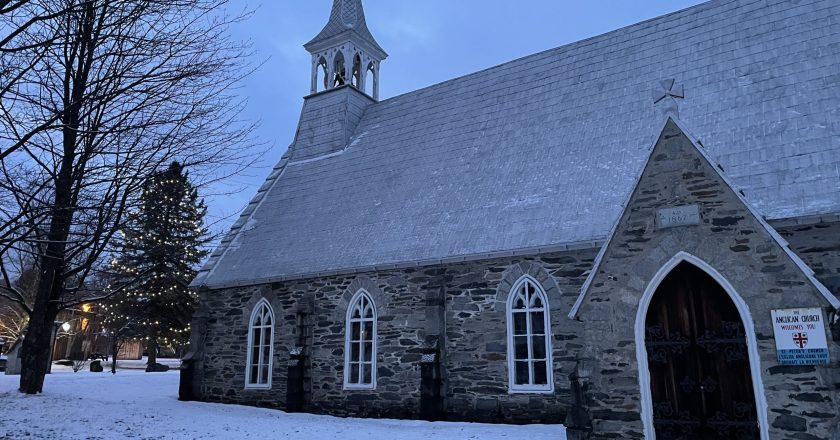
St Peter's, Décembre 2024

L’église St Peter’s : Plusieurs appels et une offre, mais l’avenir reste incertain

L’avenir de l’église St Peter’s à Cookshire-Eaton reste incertain, selon Anthony De Carvalho, agent immobilier. Il cite notamment les exigences de la ville en matière de stationnement comme un obstacle.
« Nous recevons au moins un appel tous les deux jours », a-t-il déclaré par téléphone. Une offre a été reçue, mais « le prix était tel que nous n’étions pas disposés à l’accepter ».


Aussi, « il n’avait pas de projet en tête, contrairement à M. Denis. »
Pour sa part, Gilles Denis a indiqué par courriel que la Ville de Cookshire-Eaton n’avait pas manifesté d’intérêt pour son projet de création d’une bibliothèque et qu’il avait donc informé les agents immobiliers qu’il ne ferait pas de nouvelle offre.


« Toutefois, j’ai repris contact avec le milieu pour identifier un projet qui pourrait se faire à St Peter’s, car je crois à sa conservation. »


M. De Carvalho a déclaré que la Ville de Cookshire-Eaton exige un stationnement hors rue réservé pour le bâtiment, mais que St Peter’s ne disposait pas d’un terrain suffisamment grand pour cela.
M. Denis a dit qu’il n’avait aucun problème avec l’exigence de stationnement, car il est propriétaire de l’ancien presbytère voisin et pourrait utiliser son terrain.


L’Église anglicane « a le cœur brisé de devoir vendre le bâtiment », a déclaré M. Carvalho, mais elle a besoin du produit de la vente pour aider à réparer d’autres églises. Le prix demandé de 200 000 $ « n’est qu’une goutte d’eau » par rapport aux besoins de toutes les autres églises.


Lorsqu’on lui a demandé si son agence avait fait une offre pour St Peter’s, il a répondu : « Absolument pas. Nous n’avons jamais fait d’offre pour aucun des édifices religieux que nous avons vendus. L’Église anglicane est l’un de nos plus importants clients ; nous avons vendu plusieurs de ses bâtiments. Nous ne nous mettrions jamais dans une situation de conflit d’intérêts. »


« Nous sommes ouverts à toute collaboration avec quiconque qui a un projet en tête », a-t-il ajouté. « Dans un monde idéal, ce serait quelque chose qui servirait la communauté. »

St Peter's, Décembre 2024

St. Peter’s Church : Many inquiries, but future still uncertain

The future of St. Peter’s Church in Cookshire-Eaton is still uncertain, according to Anthony De Carvalho, real estate agent. He cited the City’s parking requirements as an important drawback.
«We must get at least a call every second day,» he said in a phone conversation. One offer was received, but «the price was something that we were not willing to accept.»


Also, «the person did not have a project in mind, so it wasn’t like Mr. Denis.»
For his part, Gilles Denis emailed that the City of Cookshire-Eaton had not shown interest in his project to create a library, and he had therefore told the realtors that he would not make a new offer.

«However, I’ve been in contact with the community to identify a project that could be carried out in St. Peter’s, because I believe in its preservation.»
De Carvalho said the Ville de Cookshire-Eaton requires off-street dedicated parking for the building, but St. Peter’s does not possess enough land for this.
Denis said he had no problem with the parking requirement, because he owns the previous Presbytery next door, and could use its land.


The Anglican Church «is heartbroken to have to sell the building,» said Carvalho, but needs the sale proceeds to help repair other churches that need significant work. The asking price of $200,000 «is still a drop in the bucket» for the needs of all the other churches.


Asked whether his agency had bid on St. Peter’s, he said «Absolutely not. On all the church buildings we’ve handled, we’ve never made an offer on any of them. The Anglican Church is one of our biggest clients, we’ve sold quite a few buildings for them. We would never put ourselves in a conflict of interest.»


“We’re open to working with anyone who has a project in mind,» he said. «In an ideal world, it would be something that would serve the community.”

Rachel Garber - en-tête chroniques

On his shoulders

Sawyerville resident Colonel Garneau―Jack―was certainly a cornerstone of our community.
Sadly, he left us last October 28. I was unable to attend his celebration of life, so let me celebrate him a bit here, in our Janus moment as 2026 begins.


I first met Jack in 2000 during community discussions in advance of upcoming municipal mergers. He made an articulate plea to residents to speak up for bilingual status in the new Cookshire-Eaton, where he finished his 32-year career as municipal councillor in 2010.


“When I started, all the meetings were in English,” he told me once. “Sawyerville was 90% English-speaking then. When I finished, all the meetings were in French, and the population was mostly French-speaking.”


Were there any potholes along the way?


“It happened smoothly,” he said.


His great good humour served him well during his 33-year career as a high school teacher and principal, too, ending at Alexander Galt Regional High School.


“Moving from small, local schools to large, amalgamated schools […] was difficult, but we tried to offer courses that made it worthwhile. That was the way the government wanted it done, so we tried to take what was offered and make the very best of it,” Col. Garneau said. “And in spite of the little flaws, I think we were successful with that.”


“I thoroughly enjoyed working with people, especially young people.”
Then there were his 25 years in the Reserves. He began as a trooper with the 7/XI Hussars, and finished as Honorary Colonel in the Sherbrooke Hussars, when the two regiments merged.
His community engagements earned him “some 30” medals, he told me once. I know of three: An Outstanding Townshipper Award from Townshippers’ Association, a King Charles III Coronation Award in 2025, and the Queen’s Diamond Jubilee Medal in 2012.


His ancestors were among the earliest settlers in the area. “I’m proud that we seem, the various cultures―the three language groups because my grandmother was a Gaelic-speaking Scot―we all managed to mould together and fit in without any animosity at all,” he said. “In many parts of the world, that doesn’t happen.”


Jack Garneau had broad shoulders, strong enough for today’s community builders to stand on.
Thank you, Lois and family, for sharing him with us.

Rachel writes from the old hamlet of Maple Leaf, in Newport (rawrites@gmail.com).

©2026 Journal Le Haut-Saint-François