Rachel Garber

Rachel Garber

Rachel Garber writes from her home in the old hamlet of Maple Leaf, in Newport. (rawrites@gmail.com)
ACTU-Rachel

GHOSTS & OTHER DOOHICKEYS

The Townships Trail is launching the English version of the mystery drama created in French in 2019. “For several weeks now, something has been amiss on the Townships Trail. Objects have been disappearing or turning up in unexpected places,” reads the synopsis. “Ghost hunter Glenn Stevens has been tapped to investigate. Thanks to his paranormal detection doohickeys, he discovers…”
Ghosts & Other Doohickeys is on tour across the region along the Townships Trail, and stops at the Parc des Braves, 125 Principale West, Cookshire, on Sunday, July 24, at 4 p.m. The performance is outdoors, but if it rains, actors and audience will move into the adjacent Victoria Hall. Attendance is free of charge. Bring your own chair.
The three actors are directed by Mary Harvey; the play was written by William S. Messier.
MURMURS ON THE MURS
Look for Murmurs of the Township, or Les Murmures du Canton on the murs (walls) of three historic buildings, Victoria Hall, Cookshire Elementary School, and St. Peter’s Church, starting Thursday, June 23, at nightfall. The wordless multimedia light and video projections continue all summer on Thursdays, Fridays, and Saturdays at the Parc des Braves in downtown Cookshire.
Each show is about 30 minutes long, with two showings every evening. On average, about 15 images per second scroll across the walls, showing some 50,000 drawings. Three videos are projected simultaneously.
The show is about the history of the Eaton Township, but is also reminiscent of the Eastern Townships in general: original Abenaki residents, American soldiers, American and British settlers, and flora and fauna.
Les Murmures du Canton was launched last summer, a collaborative effort by the Productions de l’Inconnu dans le noir, the Maison de la culture John-Henry-Pope, the Town of Cookshire-Eaton, Tourism Eastern Townships, and the Quebec Ministry of Tourism.
EATON CORNER MUSEUM
At 11 a.m., the Eaton Corner Museum will open to the public, and stay open until 4 p.m. This happens June 25 and 26, and then every Thursday to Sunday during July and August. Find out about membership; it includes the Museum’s entrance fee. Where? At 374 Route 253, in Eaton Corner. Info: 819-875-5256 or eatoncorner59@gmail.com.
CANTERBURY CONCERT
On June 25 at 8 p.m., at the Canterbury Center, musicians Christian Nolet, Kevvin Hinse, and P.O. Boudreault will perform traditional Quebec music on guitar, mandolin, violin, Irish bouzouki and voice. To be among the audience of 50 persons, reserve your $15 seat by phoning Gilles Gaulin at 819-872-3273, or Ed Pedersen at 819-872-3400. Masks are suggested. Proceeds will help support the restoration of the Center’s small windows. Where? At 1095 Route 214, Canterbury.
COOKSHIRE CONCERTS
Afternoon concerts in the Parc aux Braves in Cookshire, Concerts Apéro, are back again, organized by the Cookshire-Eaton Art Gallery. On Sunday, June 26, at 5 p.m., two guitarists will play Jean-François Desrosby and Tommy Dupuis in a concert entitled Place à la relève : le maître et l’élève (Make Way for the Next Generation: the Master and the Student). In case of rain, the concert will move to the St-Camille Catholic Church, 170 Principale East.
We can look forward to a July 17th concert by the Quintette DeVito, with Robin Doyon and Stéphane Beaulac playing trumpet, Gabriel Gauthier Beaudoin on horn, Martin Ringuette on trombone, and Jean-Philippe Dutil playing tuba.
And then on August 14 is planned Ragtime et compagnie with Catherine Meunier, percussionist, and Steve Normandin, accordionist.
CANADA DAY
At the Canada Day parade in Bury on Saturday, July 2, the Bury Historical & Heritage Society will be serving strawberry shortcake. Homemade shortcake, fresh strawberries, $8 a plate, between 10 a.m. and 3:30 p.m. in the Armoury. Yours truly will be near the Armoury entrance, at a sunny yellow table showing off the new July-August issue of the Townships Sun magazine, and our new Young Voices project.
JOHN-HENRY-POPE
The tourist information bureau at the Maison de la Culture John-Henry-Pope is now open daily from 10 a.m. to 5 p.m. Where? At 25 Principale West, Cookshire.
COOKSHIRE ART GALLERY
Iridescent Thought, or Pensée irisée, the Raven Collective’s exhibition is still on, showing the work of Ann Bilodeau, Yong Sook Kim-Lambert, Laurence Bacon, and Norman Gladu. As of June 25, the gallery is open Wednesday to Sunday, 10 a.m. to 4 p.m. Where? At the Cookshire-Eaton Art Gallery in Victoria Hall, 125 Principale West, Cookshire.
CANTERBURY FLEA MARKET
To donate good quality items to the Canterbury Center fund-raising campaign, please call Tony De Melo at 819-872-3400 (leave a message) before July 15. Pick-up of items can be provided. All proceeds go to help restore the former Christchurch Canterbury, now Canterbury Center. The items will be on sale at the Canterbury Flea Market, July 30-31. Re-use, Re-cycle, Reduce!
TOWNSHIPPER WARNHOLTZ
Townshippers’ Association has a new president, Donald Warnholtz of Sherbrooke. Warnholtz is also Director General of the Dixville Foundation, and has had a 36-year career as clinical program manager in health and social services. Gerry Cutting has stepped down after 12 years as president of Townshippers’ Association. Townshippers’ has been around since 1979. Info: www.townshippers.org.
CHURCHES
Baptist. Regular in-persons services are in French at 9 a.m., in English at 11 a.m., respecting Covid protocols, including masks and hand sanitizing. For information, please contact Pastor Michel Houle at 819-239-8818.
Anglican. An in-person Sunday service is July 3, at 11 a.m. at St. Peter’s Church in Cookshire. Also, Bishop Bruce Myers offers Home Prayers at 4 p.m. on Sundays via Facebook, and at quebec.anglican.ca (Worship Videos). Info: 819-887-6802, or quebec.anglican.ca.
United. In-person Sunday services are June 26, July 3, and July 10 at Trinity United in Cookshire at 9:30 a.m., and at Sawyerville United at 11 a.m. In case of any changes, please check the United Eaton Valley Pastoral Charge answering machine after Friday at 819-889-2838.
Do you have news to share? Call 819-640-1340 or email rawrites@gmail.com by June 27 for publication July 6, and by July 11 for August 3.

ACTU-Rachel

CONSPIRACY OF RAVENS

I hope you are not ornithophobic.
If you do have a fear of birds, you could be freaked out by the new show at the Cookshire-Eaton Art Gallery. It’s put on by a conspiracy of ravens.
Just kidding, but only partly. Yes, ravens usually hang out in pairs; not in murders, as crows do. But when they do group together, they’re an “unkindness” or a “conspiracy.” And they definitely are unkind, mostly a rowdy bunch of young males fighting for dominance and females seeking mates. Researcher Bernd Heinrich at the University of Vermont (livescience.com) called such a group a “mobile discotheque” and said the sight of them could induce Hitchcockian flashbacks to The Birds, that famous horror movie. It’s enough to stress out the ravens themselves, he said.
But no, the Raven Collective of artists is not unkind, although their conspiracy is a touch boisterous.
They are, in fact, a group of five Townships artists who come from away and have spread their wings abroad, but have returned to the nest, so to speak; the group first exhibited in Cookshire in 2015.
That was when Robert Peloquin joined forces with Ann Bilodeau and Yong Sook Kim-Lambert. Today, the group has grown to five, with Laurence Bacon and Normand Gladu of Saint-Isidore-de-Clifton joining the conspiracy. Their approaches are varied: Peloquin sculpts in glass, metal and stone. Bilodeau draws and collages. Kim-Lambert paints in acrylic. Bacon weaves and uses vegetation-based inks. Gladu sculpts high reliefs in found objects and mixed media.
What is their affinity? You might say Nature, or in the words of their press release, “the expressive power of matter (materials and subject) and the act of storytelling.”
They explore “the realms of interaction between humans, other living beings and the social, intimate and physical spaces that they occupy.”
Another interaction in their work is between the abstract and the actual; the suggestion of a story stimulates the mind of the beholder to put flesh on its bones. That brings us to the topic of this exhibit: Iridescent Thought, or Pensée irisée. That’s what art is about, isn’t it? Materials shaped to express thought; matter divulging spirit.
The Raven Collective presents a crunchy combination. The works are varied and rich, colourful and intriguing. You can sink your teeth into this exhibit.
The exhibit is at the Cookshire-Eaton Art Gallery, 125 Principale West, until July 17. The spacious gallery is open weekends, 12 to 4 p.m., until June 24; after that it is open Wednesday to Sunday, 10 to 4 p.m.
PIONEER WOMEN
Is – or was – she her own woman? Does – or did – she live in the Townships? How has she helped shape Townships history?
Think of a woman you could describe in those terms. Adèle Blais would like to hear from you. She’s a Sherbrooke artist whose 22 portraits of such women as Ella Fitzgerald populate a book, Fortes. Blais’s current project is to create an exhibit of pioneer women in the Eastern Townships for a 2023 exhibit at the Musée des beaux-arts de Sherbrooke. She’s inviting all of us to nominate just such a person by sending her several photos of a woman pioneer, and a 500-word text about her. The world of business, art, volunteerism, ideas – the list of domains women have helped build could go on and on.
Blais’s deadline is July 1st; she asks that suggestions be sent by email to info@adeleblais.com. To see Blais’s striking portraits in paint and collage, visit adeleblais.com.
EATON CORNER MUSEUM
The Eaton Corner Museum will open to the public on June 24 to 26, from 11 a.m. to 4 p.m. Entrance fees are $8 for adults, $6 for seniors, and $4 for youth. Membership includes entry to the Museum. During July and August, the Museum will be open Thursday to Sunday from 11 a.m. to 4 p.m. It is located at 374 Route 253, in Eaton Corner. Info: 819-875-5256 or eatoncorner59@gmail.com.
JUNE 24th CONCERT
Canterbury Center is hosting a concert in celebration of the Fête Nationale du Québec on Friday, June 24, at 8 p.m. Musicians Christian Nolet, Kevvin Hinse, and P.O. Boudreault will perform traditional music of Quebec on guitar, mandolin, violin, Irish bouzouki and voice.
Only 50 tickets will be sold. To be among the 50 lucky people in the audience, reserve your $15 seat by phoning Gilles Gaulin at 819-872-3273, or Ed Pedersen at 819-872-3400. Masks are suggested. Proceeds will help support the restoration of the Center’s small windows. The Canterbury Center is located at 1095 Route 214, Cantberbury.
SUNRISE
Discover what would have made Charles Bury go berserk. With Scott Stevenson and Brenda Hartwell, explore how Townships musicians and thespians weathered the pandemic. Read a story by Marc Boucher about a family in crisis, dealing with raw questions. Learn how NOT to herd porcupines. Find out how to plog and plalk.
Yes, the June issue of the Townships Sun has hit the newsstand at the Cookshire IGA. Better yet, subscribe at thetownshipssun.org, or 819-566-7424.
CHURCHES
Anglican. In-person Sunday services are June 12, at 10:30 a.m., at St. John’s Church in Brookbury, and June 19 at 11 a.m. at St. Peter’s Church in Cookshire. Also, Bishop Bruce Myers offers Home Prayers at 4 p.m. on Sundays via Facebook, and at quebec.anglican.ca (Worship Videos). Info: 819-887-6802, or quebec.anglican.ca.
United. In-person Sunday services are at Trinity United in Cookshire at 9:30 a.m., and at Sawyerville United at 11 a.m. In case of any changes, please check the United Eaton Valley Pastoral Charge answering machine after Friday at 819-889-2838.
Baptist. Regular in-persons services are in French at 9 a.m., in English at 11 a.m., respecting Covid protocols, including masks and hand sanitizing. For information, please contact Pastor Michel Houle at 819-239-8818.
Do you have news to share? Call 819-640-1340 or email rawrites@gmail.com by June 13 for publication June 22, and by June 27 for July 6.

Rachel Garber

WHY I DON’T SEW

“Prepare yourself mentally for sewing. Think about what you are going to do. Never approach sewing with a sigh or lackadaisically. Good results are difficult when indifference dominates. Never try to sew with a sink full of dirty dishes or beds unmade.”
That’s from the Singer Sewing Machine Manual. It was published in 1949, not long before I was launched into my youthful indoctrination on how to grow up to be a woman. The manual’s instructions continue:
“When there are urgent housekeeping chores, do these first so that your mind is free to enjoy your sewing. When you sew, make yourself as attractive as possible. Put on a clean dress. Keep a little bag of French chalk near your sewing machine to dust your fingers at intervals. Have your hair in order, powder and lipstick put on. If you are constantly fearful that a visitor might drop in or your husband will come home, and you will not look neatly put together, you will not enjoy your sewing.”
I retch. I’m hearing these words in the voice of Aunt Lydia of Handmaid’s Tale fame as she explains the rules that dominate women in the Republic of Gilead. I do not miss the overt suggestion that I should be “constantly fearful … [my] husband will come home” when I am not dressed up. What are the consequences? I will leave this to the gentle reader’s imagination.
Who reminded me of this advice – and yes, it is genuine, per fact-checker Snopes.com – was Margaret Atwood in an interview I recently watched via zoom. The topic was Burning Questions, her new book of essays.
The interviewer asked her to comment about the current abortion controversy in the United States. She had some telling comments. One was the common-sense observation that if society requires women to bear children, it is in fact engaging their services. Women conscripted for these services should have the same benefits and salaries as military recruits. Think about it: military personnel put their physical bodies at the service of the state; so do child-bearing women. Aren’t child-bearing and child-rearing a battle, in many ways?
Yes, of course, the circumstances surrounding childbirth are much more complex than simply remuneration. For most parents, having children is enormously rewarding and joyous, maybe the best experience in life. That has been my experience, too.
At the same time, as a single parent, I can tell you that balancing the hands-on care of a child with the need to make a living is overwhelming. Rigid workplace demands oppose essential child-rearing demands, and the scale on which one balances priorities simply breaks down.
The shortage of baby formula revealed to the world that only a quarter of babies in the United States are breastfed. In Canada, it’s about 34 percent by the age of six months, reported a study in the International Journal for Equity in Health, and many of the mothers who don’t nurse are economically disadvantaged. While the reasons for choosing not to nurse can vary, the necessity to work at a job that precludes nursing is a big one.
Then a shortage of baby formula happens, and the whole system breaks down. Who suffers the most? It’s a toss-up between the hungry baby and the mother desperately seeking to save her child.
Take away a woman’s right to make decisions about her own body and life, trap her in an impossible predicament, and you have the stuff that revolutions are made of: a hefty proportion of the population with nothing to lose.
I see the focus on regulating a woman’s body as a throw-back to the era of woman-as-chattel who must fearfully please her master, à la Singer Sewing Machine instructions.
Why is it hard for me to believe anti-abortion sentiment has anything to do with the life of the child? Because society arranges itself to care so little for that life after the child is born. As a village, we have failed our children and their mothers, in so many ways.
Well, that pretty much sums up why I don’t sew.
JUNE 24th CONCERT
Canterbury Center is to host a concert celebrating the Fête Nationale du Québec on Friday, June 24, at 8 p.m. Musicians Christian Nolet, Kevvin Hinse, and P.O. Boudreault will perform traditional music of Quebec on guitar, mandolin, violin, Irish bouzouki and voice.
Only 50 tickets will be sold. To be among the 50 lucky people in the audience, reserve your $15 seat by phoning Gilles Gaulin at 819-872-3273, or Ed Pedersen at 819-872-3400. Masks are suggested. Proceeds will help support the restoration of the Center’s small windows. The Canterbury Center is located at 1095 Route 214, Cantberbury.
“THREE R’S” FOR CANTERBURY
If you have good quality items that you would like to donate to the Canterbury Center fund-raising campaign, please call Tony De Melo at 819-872-3400 (leave a message) before July 15. Pick-up of items can be provided. All proceeds go to help restore the former Christchurch Canterbury, now Canterbury Center. The items will be on sale at the Canterbury Flea Market, July 30-31. Re-use, Re-cycle, Reduce!
CHURCHES
United. In-person Sunday services are in Cookshire at 9:30 a.m., and Sawyerville, 11 a.m., with Rev. Tami Spires. For service information, please check the United Eaton Valley Pastoral Charge answering machine at 819-889-2838.
Baptist. Regular in-persons services are in French at 9 a.m., in English at 11 a.m., respecting Covid protocols, including masks and hand sanitizing. For information, please contact Pastor Michel Houle at 819-239-8818.
Anglican. In-person service on Sunday, June 5, at 11 a.m., at St. Peter’s Church in Cookshire. Also, Bishop Bruce Myers offers Home Prayers at 4 p.m. on Sundays via Facebook, and at quebec.anglican.ca (Worship Videos). Info: 819-887-6802, or quebec.anglican.ca.
Do you have news to share? Call 819-640-1340 or email rawrites@gmail.com by May 30 for publication June 8 and by June 13 for June 22.

ACTU-Rachel

GROWING PAINS

It’s been a challenging winter. Yes, yes, I know, the weather.
But that wasn’t the half of it. The editor of The Townships Sun suddenly passed away, and I had the chutzpah to step in. It’s been a wild ride, fun all the way. I get to work with lots of creative types, all across the Townships.
For the May issue – now on the newsstand at the Cookshire IGA – I visited a slew of ceramic artists who create a kind of alchemical transformation using clay, fire and water. John Mackley writes about his experience as a “Back to the Lander,” and a new generation of them in the Townships today. Scott Stevenson writes about the growing pains of organic farming, stymied by a policy that requires “healthy farming” to “pay to certify its status, while farms using toxic chemicals don’t shoulder that extra cost.”
There’s a story by Janice LaDuke nestled in among the articles, poetry, art and photos by other Townshippers. (Notice all my mentions are of Haut-Saint-Franciscans.) And there’s a description of Young Voices, a new project that aims to involve a new generation of creative types – writers, artists and photographers – in our community and our community magazine, The Townships Sun.
This issue is the last one in Volume 49, on the cusp of the magazine’s 50th anniversary. It was started by a small group of young people – many from around here: Russell Pocock, Roderick Macdonnel, Brian Olding, Susan Mastine, Robert Winter, Bernard Epps. The logo was designed by Stephanie Wells of Scotstown, and shows the sun peeking over the Megantic mountains.
That was then; now we need more readers and contributors from our neck of the woods. Visit TheTownshipsSun.org to get three recent issues in pdf for free, and also to subscribe. A year is only $15 (e-subscription – a pdf version in full-colour), or $25 for the print version. Join us in the Sun!
HAIKU ZOOM
An evening of Haiku readings and conversations is Friday, May 13, at 7:30 p.m., an online launch party for three nifty little poetry books. They are Last Summer Pear, by Angela Leuck, Spring to Lips by Phyllis Sise, and Ditch Walker, by Bernice Angeline Sorge. The poetry is short, the books are little, but all are mighty in humour, beauty, and the joys of nature. Get the link for this free session by contacting bulla@ubishops.ca. The event is organized by the Bishop’s University Lifelong Learning Academy, Write Here Write Now, and Yarrow Press, an imprint of Shoreline Press, right here in the Townships, and the publisher of all three books.
YOU CAN TOO
Write Here Write Now (WHWN) continues to offer free Zoom workshops for new and other writers. For the past year or so, I’ve been participating as both a learner and a leader in these varied workshops. They’ve given me inspiration, ideas, and encouragement, and also an opportunity make new friends among creative persons in the Townships.
Here is what’s coming up: Rebecca Welton offers an introductory workshop on writing Short Fiction on May 11 and June 11, and Short Fiction Readings are planned for June 12. She leads another workshop, Beginner Blogging for Authors, on May 12. For writers of children’s literature, Rebecca Facilitates a Estrie Kidlit Meeting on May 15. All of Rebecca’s workshops are at 1:30 to 3:30 p.m.
On Tuesdays, May 17 and June 17, I myself lead a workshop on Editing and Giving Feedback, and on Tuesday, May 31, a special workshop on the Ins & Outs of Magazine Writing – you guessed it, I’m looking for new writers for The Townships Sun! My workshops are at 10 a.m. to noon.
On Thursday, May 26, Jan Draper leads a workshop on Poetry; then on June 3, a Poetry Reading Practice Session. Both are from 1:30 to 3:30 p.m. Viewers and readers are invited to a Poetry Reading on June 17, from 7 to 9 p.m.
Etienne Domingue leads a Fantasy Fugue Forum – on fantasy writing – on May 30 and June 27, at 7 to 9 p.m. Two last workshops are one on Art and Writing led by Christopher Brandon, May 21, and Local Journalism offered by Gordon Lambie, May 28. Both are at 2 to 4 p.m.
For the link for any of these workshops, contact bulla@ubishops.ca.
TREE GIVEAWAY
For families of Pope Memorial School students and residents of Bury, the Eaton Valley Community Learning Centre is giving away trees on Friday, May 20, from 2 to 6 p.m. at the school, 523 Stokes, Bury. Trees are free, two per person, while quantities last. For details, see the Eaton Valley CLC Facebook page, says Jenny Ménard of the CLC at the Pope Memorial and Sawyerville elementary schools. The trees are offered by the Quebec ministry of forests, fauna and parks, in celebration of May, the month of trees and forests.
IMAGINARY WORLDS
An art exhibit at the Cookshire-Eaton Art Gallery presents three imaginary worlds by three contemporary artists: François Haguier, Guy-Anne Massicotte, and Manon Potvin. The show is open Saturdays and Sundays, 12 to 4 p.m., until May 22, at the gallery, 125 Principale West, Cookshire-Eaton.
CHURCHES
Baptist. Regular in-persons services are in French at 9 a.m., in English at 11 a.m., respecting Covid protocols, including masks and hand sanitizing. For information, please contact Pastor Michel Houle at 819-239-8818.
Anglican. In-person service on Sunday, May 15, at 11 a.m., at St. Peter’s Church in Cookshire. Also, Bishop Bruce Myers offers Home Prayers at 4 p.m. on Sundays via Facebook, and at quebec.anglican.ca (Worship Videos). Info: 819-887-6802, or quebec.anglican.ca.
United. For service information, please check the United Eaton Valley Pastoral Charge answering machine at 819-889-2838. For pastoral emergencies, contact Rev. Mead Baldwin at 819-837-1112.
Do you have news to share? Call 819-640-1340 or email rawrites@gmail.com by May 16 for publication May 25 and by May 30 for June 8.

Rachel Garber

The English

I can’t count the number of times I’ve been called “English,” starting in Amish Country, especially in Lancaster County, Pennsylvania.
“English” is what Amish people call anyone who do not speak Pennsylvania Dutch. Yes, they would even use that label for French speakers, I think. It’s a binary world view: You either are or are not one of the 300,000 native speakers of Pennsylvania Dutch in North America. If you don’t speak that language, you are English. Yes, I fall into that category.
But, no, I never thought of myself as English. My father’s first language was Pennsylvania Dutch, a dialect of German that comes from the Palatine region of Southern Germany, Alsace and Lorraine in Eastern France, and parts of Switzerland. (No, not the Netherlands: “Dutch” is a corruption of “Deutsch,” which means German.) My family were Mennonites, close cousins to Amish, although they now mostly speak English.
I always assumed my DNA was 100 percent Swiss German, from the canton of Bern in Switzerland. In family stories, Northern Switzerland was always the starting point of my ancestors’ migration to the New World. Beginning in 1663 the migrations began, mainly to escape religious persecution. They were an insular group; I never heard of one instance of intermarriage with a “worldly” person, not before my generation.
Thing is, if you married a non-Mennonite, it almost always meant you’d left the church, and your branch of the family tree was broken off right there, and the family no longer had contact with you. That’s sort of what happened to me, although times have changed and I enjoy a close relationship with my immediate family.
I’ve been in Quebec now for 48 years, and I am still irritated and bemused when I hear persons whose first language happens to be English labelled, with various overtones, “les anglais.” The brand “English” carries connotations that may be friendly, derisive, resentful or bitter. For me, the first barrier to speaking about those feelings is the widespread blindness to the great diversity among the people lumped together under that label.
Now, to my amazement, I have to admit I’m a bit guilty of that same blindness, in relation to my own ancestry. I recently had my DNA analyzed, and no, I am not 100 percent Swiss German! In fact, only 48 percent of my DNA resembles that of people from Germanic Europe, an area taking in Germany, Czechia, Austria, Switzerland, Luxembourg, Belgium and the Netherlands.
(Switzerland – Bingo! But only 48 percent?!)
Now I have to have a chat with my neighbour and figure out how we are cousins, because a full 22 percent of my DNA is French. Really? French?
My older brother enlightens me. “Some intermarriage for Amish and locals in Alsace-Lorraine?” Oh yes, I recall my mother’s history lessons about the Alsace-Lorraine region in eastern France; it was ceded to Germany in 1871 after the Franco-Prussian War, and handed back to France in 1918 after the First World War. But that was after my ancestors had migrated to Pennsylvania. I had not realized my family’s personal interest in the Alsace-Lorraine story, or that my Mennonite ancestors could have intermarried with French persons.
Am I ready to own my French side? Absolutely! Is that what motivated me to study French while a student in Virginia? Is that what destined me to settle in Quebec? Hmm.
But the rest of me? Well, 20 percent of my DNA is similar to persons from Belgium and/or England, including the Channel Islands. Now Belgium is easy to understand; I know family stories of my ancestors coming to the New World via Belgium. One young couple were kidnapped; the ship’s captain enticed them to stay aboard overnight to bid their friends farewell. The ship was to leave in the morning.
Well, when morning came, they were far out to sea. To get his passage money, the captain sold them as indentured servants to a Captain Morgan of Morgantown, Pennsylvania. So the story goes. No mention of intermarriage in Belgium, but it could have happened.
And then the last 10 percent: Sweden and Denmark. I bow to my mother’s blue-eyed family, and our Viking forebears – the word “our” referring to so many northern Europeans, including French, most likely. So maybe it’s time to stop thinking of “the French” as a monolith. Could “they” be just as variegated as “we” are?
THANK YOU
April 24-30 is Volunteer Week, and the Centre d’Action Bénévole du Haut-Saint-François takes the occasion to thank all our volunteers for everything they do. The motto this year? Volunteering is Empathy in Action. “Volunteering can help us develop empathy and see the world through the eyes of others. Thank you for all your caring, compassion and contributions to our communities,” wrote Diane Grenier, volunteer coordinator with the CAB. She can be reached at 819-560-8540 or coordo@cabhsf.org.
FUSILIERS DE SHERBROOKE
The music of Leonard Bernstein, Jan Van der Roost, George Gershwin and John Williams: the Fusiliers de Sherbrooke bring a breath of fresh air in Cookshire on Saturday, April 30 at 3 p.m., at the St-Camille Church, 170 Principale East, Cookshire-Eaton. Proceeds will benefit the Maison de la Culture John-Henry-Pope.
CHURCHES
Anglican. In-person service on Sunday, May 1st, at 11 a.m. at the St. Peter’s Church Hall in Cookshire. Also, Bishop Bruce Myers offers Home Prayers at 4 p.m. on Sundays via Facebook, and at quebec.anglican.ca (Worship Videos). Info: 819-887-6802, or quebec.anglican.ca.
United. For service information, please check the United Eaton Valley Pastoral Charge answering machine at 819-889-2838. For pastoral emergencies, contact Rev. Mead Baldwin at 819-837-1112.
Baptist. Regular in-persons services are in French at 9 a.m., in English at 11 a.m., respecting Covid protocols, including masks and hand sanitizing. For information, please contact Pastor __ Houle at 819-239-8818.
Do you have news to share? Call 819-640-1340 or email rawrites@gmail.com by May 2 for publication May 11, and by May 16 for May 25.

Jack anglais

One Sawyerville Resident’s DNA: All Mixed Up

Jack Garneau: 100 percent.

Scottish, English/Northwest Europe, Irish, Norwegian, French, Slavic, Native American: One person’s DNA, in that order of proportion. Perhaps you recognize the package?
That’s the portrait Ancestry.com paints of Jack Garneau. It’s not unlike many other so-called “English” in the Haut-Saint-François, he guessed.
In fact, “being English-speaking” is not at all the same as “being English,” I observed, and Garneau acknowledged with a hearty laugh how often the two are confused. We talked by phone, he from his home in Sawyerville.
The genealogy buff has looked into his roots, and being 85, he’s had a bit of time to do so in depth.
“Ancestry tells me that my genes are only two percent similar to those from France, yet they tell me I am connected to all French people in North America.”
He has French heritage from his great-grandfather on his father’s side, and his great-grandmother on his mother’s side. “So I would have thought that percentage would be higher. But I suppose people who came from France, they probably weren’t totally genetically French either. They probably were partly Viking or Scandinavian, who knows?”
Another surprise was his predominant Scottish DNA. “My dad’s mother came from the Isle of Lewis,” he said. “My mother always said her father was Irish. But I think most of her roots were what they called planters.”
“Planters” were people from England and Scotland brought into northern Ireland to settle the land in the early 1600s, Protestants who were friendly to the English crown. They became known as Irish, but had Scottish origins.
The “English-Northwest Europe” part of the package referred, in part, to his great-great-grandfather who came over from Germany to Boston in 1751.
“The Boston settlers were getting a lot of grief from the French and Aboriginal people, so they brought over immigrants to settle on the outskirts of Boston. ‘Better they lose their scalps than we lose ours’,” Garneau said.
They invited Lutherans from the northern part of the Rhine valley; the Bostonians feared Catholic immigrants would be too easily influenced by French-Quebecers. Seven families collectively farmed a thousand-acre piece of land for a number of years, then Garneau’s ancestors gradually moved north, up the Connecticut River, and settled in Eaton.
“It doesn’t take very long to go from an ancestor 100 percent to one percent, really. My Native ancestry is eighth generation on the Huron side, and eleventh on the Algonquin side, and yet they say I’m only a small percentage Native American,” Garneau observed. His ancestors were among the “first Métis” in Canada, in the 1600s.
“I may not have much of their DNA left, but if they weren’t there, we wouldn’t be here.”
His English ancestors, the Page family, came to the New World in the 1600s, soon after the Mayflower. “They came up to the Eaton area around 1800 or 1805.” Like many other Americans at that time, they came for land, he noted, not politics. “They were not Loyalists.”
Around the 1850s, Garneau’s French ancestors moved south into the Bury area. His Geurtin ancestors supported the British in the Rebellion of 1837, but his great-great-great uncle, Hippolyte Lanctot, a notary in Saint-Constant, fought on the side of the Patriots. He was captured and shipped off to Australia. After some years, his sentence was commuted and he came back to Montreal.
“So here he was, a Patriot, and on the other side of my family, they were against that. Near Quebec City, the Irish there were afraid of what was going on. George Abraham Smyth, my great-great-great grandfather, petitioned Lord Dorchester to give them arms and give them aid so they could protect the area against the Patriots and I have a copy of the document he wrote to Lord Dorchester,” he said.
Then there are his Slavic roots: Ukrainian or Russian. Garneau compares the current war to the times of the Viking raids in Europe. “I guess unfortunately it’s been the story of mankind. Really, I just cannot comprehend. We’ve been led to believe we can talk things out, but I’m not so sure. History doesn’t seem to show we’re very successful at that.”
That’s one lesson we can learn from our DNA. Garneau summed up another: “We’re all mixed up, actually!”

Oasis

Oasis in the Cookshire Elementary School

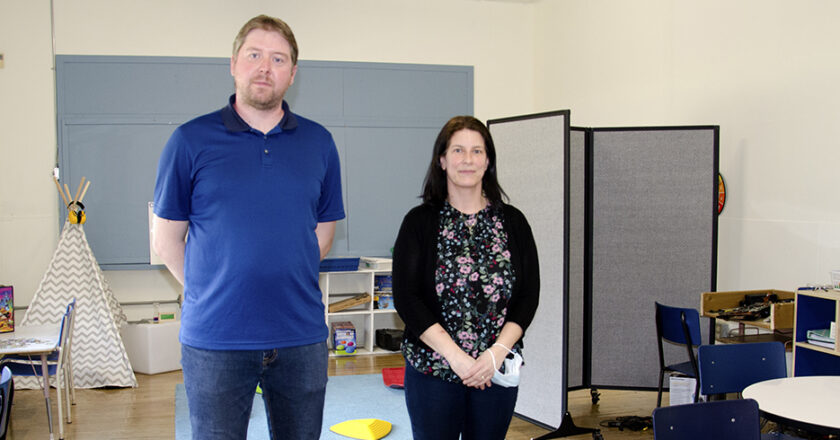
Kevin Dezan and Tina Jacklin in the new Oasis of the Cookshire Elementary School.

Tina Jacklin, Kevin Dezan, and Noemie Caya greet me at the door to the room. We’re in the Cookshire Elementary School, where Jacklin is principal, Caya is psychoeducator, and Dezan is special education technician.
I’m here to tour the Oasis. It’s a spacious room created in November 2021 to help children with feelings that can distract them from learning.
“We are definitely seeing an increase in problems – the pandemic has been stressful for everyone. I think children feel the stress that parents are under,” said Jacklin.
“But we had problems beforehand, as well,” Dezan noted. “There were days when Tina and I would just be going around from crisis to crisis. We started thinking there’s got to be a better way.”
Dezan and Caya visited the elementary school in Danville which already had an Oasis. “We came back with a lot of ideas, and with a lot of optimism as well.”
Dezan himself is a key feature of the room, but it has a lot of other attractions, too.
Just inside the door is a “check-in space,” a small couch facing a four-colour display of “zones” of emotions. Blue stands for a family of “down” feelings; green, a “relaxed and ready to learn” state; yellow, frustrated or worried feelings, and red, an angry or out-of-control state.
Each student positions their name card within one of the zones. Dezan takes note, talks with the child about how they’re feeling and what just happened, and sets a timer for how long their break will be – five or ten minutes, max. “The breaks,” he said, “give a student time to reflect, and give me a chance to help them learn tools and strategies that get them out of the situation.”
Some of the room’s features are designed to relieve anxiety, such as “fidgets” for restless hands. Some provide rest, like a little isolation-cube bed with stuffed animals, or a one-person teepee with noise-cancelling headphones. A dartboard with velcro and styrofoam balls might help raise a person’s energy level.
The demolition corner might be where a person releases excess energy by tearing apart a laptop (while wearing safety glasses, to be sure). Stepping stones meander across the carpet. Meditative or calming strategies abound: special markers for drawing on the window panes that overlook the playground, a Lego wall, a kinetic sand box, puzzles, or colouring pages. Breathing techniques: “smell the flower, blow out the candle.”
The Oasis is used preventively, as well. “We note when certain kids often have outbursts, and schedule a break so they come in here before it happens,” Dezan said.
Jacklin said each classroom has a little teepee, “a calming corner,” where children can take a short break during class if they feel the need.
The Cookshire Elementary School has 104 students in pre-Kindergarten to Grade 6. At first, only 10 or 15 children visited the Oasis in a day; now 20 or 30 do. They come for different reasons: For a scheduled break, because of problem behaviour, or even to do schoolwork.
“Some come because they’ve earned a break, too,” said Jacklin. “We’re trying to have a space where everyone can come. We don’t want it to be seen as a bad place. It’s a place that is helpful, and everyone can come and benefit from having a conversation.”
“Even as adults, we’re not always in that perfect happy zone,” said Dezan. “You can feel all sort of different emotions in a day, and it’s ok. We try to give students ideas about how to work through those emotions and get back into a happier more ready-to-learn place.”
The Oasis approach is working, observed Jacklin. “For the benefits, it definitely was not costly.”

jack francais

L’ADN d’un résident de Sawyerville : tout un mélange

Jack Garneau : 100 pour cent.

Écossais, Anglais/Europe du Nord-Ouest, Irlandais, Norvégien, Français, Slave, Amérindien : l’ADN d’une personne, dans cet ordre de proportion. Peut-être reconnaissez-vous l’amalgame?
C’est le portrait que dresse Ancestry.com de Jack Garneau. Ce n’est pas sans rappeler bien d’autres soi-disant « anglais » du Haut-Saint-François, devine-t-il.
En fait, « être anglophone » n’est pas du tout la même chose que « être anglais », ai-je observé, et M. Garneau a reconnu avec un rire chaleureux à quel point les deux sont souvent confondus. Nous lui avons parlé au téléphone, chez lui à Sawyerville.
Le passionné de généalogie s’est penché sur ses racines et, à 85 ans, il a eu un peu de temps pour le faire en profondeur.
« Ancestry me dit que seulement deux pour cent de mes gènes sont semblables à ceux de la France, mais ils me disent que je suis connecté à tous les Français d’Amérique du Nord. »
Il a un héritage français par son arrière-grand-père du côté de son père et son arrière-grand-mère du côté de sa mère. « Alors j’aurais pensé que ce pourcentage serait plus élevé. Mais je suppose que les gens qui venaient de France n’étaient probablement pas totalement français génétiquement non plus. Ils étaient probablement en partie Vikings ou Scandinaves, qui sait ? »
Une autre surprise était l’ADN écossais prédominant. « La mère de mon père est venue de l’île de Lewis », a-t-il déclaré. « Ma mère a toujours dit que son père était irlandais, mais je pense que la plupart de ses racines étaient ce qu’ils appelaient des colons planteurs ».
Les « planteurs » étaient des gens d’Angleterre et d’Écosse amenés en Irlande du Nord pour coloniser la terre au début des années 1600, des protestants qui seraient amis de la couronne anglaise. Ils sont devenus connus comme Irlandais, mais avaient des origines écossaises.
La partie « anglaise/Europe du Nord-Ouest » faisait référence dans une certaine mesure à son arrière-arrière-grand-père qui est venu d’Allemagne à Boston en 1751.
« Les colons de Boston recevaient beaucoup de chagrin des Français et des Autochtones, alors ils ont fait venir des immigrants pour s’installer à la périphérie de Boston. Mieux vaut qu’ils perdent leur cuir chevelu que nous perdions le nôtre », a dit M. Garneau.
Ils ont invité des luthériens de la partie nord de la vallée du Rhin; les Bostonnais craignaient que les immigrants catholiques ne soient trop facilement influencés par les Canadiens français. Sept familles ont collectivement cultivé un terrain de mille acres pendant plusieurs années. Les ancêtres de M. Garneau se sont progressivement déplacés vers le nord, en remontant la rivière Connecticut, et se sont installés à Eaton.
« Il ne faut pas très longtemps pour passer d’un ancêtre à 100 % à 1 %, vraiment. Mon ascendance autochtone est de la huitième génération du côté Huron et de la onzième du côté Algonquin, et pourtant on dit que je n’ai qu’un petit pourcentage amérindien », a observé M. Garneau. Ses ancêtres étaient parmi les « premiers Métis » au Canada, dans les années 1600.
« Je n’ai peut-être plus beaucoup de leur ADN, mais s’ils n’étaient pas là, nous ne serions pas ici. »
Ses ancêtres anglais, la famille Page, sont venus dans le Nouveau Monde au cours des années 1600, peu après le Mayflower. « Ils sont arrivés dans la région d’Eaton vers 1800 ou 1805. » Comme beaucoup d’autres Américains à cette époque, ils sont venus pour la terre, a-t-il noté, pas pour la politique. « Ce n’étaient pas des loyalistes. »
Vers les années 1850, les ancêtres français de M. Garneau se sont déplacés vers le sud dans la région de Bury. Ses ancêtres Geurtin ont soutenu les Britanniques lors de la Rébellion de 1837, mais son arrière-arrière-arrière-grand-oncle, Hippolyte Lanctot, notaire à Saint-Constant, a combattu aux côtés des Patriotes. Il a été capturé et envoyé en Australie. Après quelques années, sa peine a été commuée et il est revenu à Montréal.
« Il était donc ici un patriote et de l’autre côté de ma famille, ils étaient contre ça. Près de Québec, les Irlandais là-bas avaient peur de ce qui se passait. George Abraham Smyth, mon arrière-arrière-arrière-grand-père, a demandé à Lord Dorchester de leur donner des armes et de les aider afin qu’ils puissent protéger la région contre les Patriotes et j’ai une copie du document qu’il a écrit à Lord Dorchester », a-t-il déclaré.
Ensuite, il y a ses racines slaves : ukrainiennes ou russes. M. Garneau compare la guerre actuelle à l’époque des raids vikings en Europe. « Je suppose que malheureusement, c’est l’histoire de l’humanité. Vraiment, je ne peux tout simplement pas comprendre. Nous avons été amenés à croire que nous pouvons parler des choses, mais je n’en suis pas si sûr. L’histoire ne semble pas montrer que nous avons très bien réussi à cet égard. »
C’est une leçon que nous pouvons tirer de notre ADN. M. Garneau en résume une autre : « En fait, on est tous un mélange ! »

Rachel Garber

14dbcD3gXf5eHkYuA2PYf2nakQ5B7hVqHj

An untitled email. The sender’s address? My own. Of course I begin to read it.
“Greetings! Have you seen lately my e-mail to you from an account of yours? Yeah, that merely confirms that I have gained a complete access to device of yours.”
“Complete access”? Is this a new twist on home invasions – a computer invasion? I feel pillaged.
The feeling is so strong, I ignore the grammatical anomalies (“Have you seen lately,” for example. “Have you recently seen” would be a more usual construction. “A complete access” is wrong; “complete access” is right. “To device” is bad; “to a device” is good.)
Those are telltale signs this is a scam. But what if the scammer has indeed taken over my computer? I read on.
“Within the past several months, I was observing you.” (That should be “have been observing you.”)
“Are you still surprised how that could happen? Frankly speaking, malware has infected your devices and it’s coming from an adult website, which you used to visit.”
Aha! Now we have veered into total fiction. Who knows, I may have malware, but I am quite certain neither I nor anyone else has been using my computer to visit adult websites. I have confirmation the threat of “complete access” and being observed for months is entirely fabricated. But what about the malware threat?
I read on. The unnamed sender says he has been watching me via my computer’s camera and microphone and has my entire list of contacts and emails, but that his malware is untraceable; it “utilizes drivers, which update the signatures on 4-hourly basis, which turns them to become untraceable.”
He says he has two videos: one shows me “wanking,” the other, what I am watching while doing so. He will release them to all my social networks and email contacts, unless I “transfer $1350 in Bitcoin equivalent to [his] wallet.”
It’s blackmail, pure and simple. The final clincher: “If, get to know that you tried to send this message to anyone else, I will distribute your video as described earlier.”
Now I’m laughing out loud. How ludicrous! But wait – let’s report it. But who to?
Why, to the most bilingual department of the Quebec Government, of course: Revenu Québec. It’s online at revenuquebec.ca/en/contact-us/contact-us-individuals/report-a-loss-or-theft-of-personal-information/, or 1 800 267-6299 (option 2).
The Canada Revenu Agency has scads of information about scams and fraud (canada.ca/en/revenue-agency/campaigns/fraud-scams.html), but I cannot find any blackmail attempts listed there that try to teach me how to “buy bitcoin” and transfer $1350 to the scammer’s “bitcoin wallet address (BTC Wallet): 14dbcD3gXf5eHkYuA2PYf2nakQ5B7hVqHj.”
Hah! What a magnificent address. I’m sure no one would be able to trace it. And I’m quaking in my boots that having written about this tawdry attempt at intimidation, I risk exposure. Hah!
Long story short, I click on “report scam” and get rid of this piece of trash.
You know, maybe the internet cuts down on paper (maybe!), but it certainly opens the floodgates to a lot of virtual scum. Every new disaster in the world—the invasion of Ukraine, the climate disaster unfolding around us, the pollution crisis, the Covid era, the accelerating extinction of species, the proliferation of porn sites—any and all can used as a basis to try to snatch personal information or money from us. The virtual waters are shark-infested.
MICHELLE LEPITRE
Congratulations to Michelle Lepitre of Cookshire-Eaton for her promotion to the new top management team of Townshippers’ Association. She and Maggie Severs are the new two-person team, with Lepitre directing programs and communications, and Severs responsible for operational management and public relations. They will share responsibility for day-to-day operations, human resources, administration and advocacy.
“It is important to us to represent the interests of our fellow community members—as we have been doing for several years now through our agent roles in the health and social services,” said Michelle. We want all English speakers in the Townships to feel like Townshippers’ Association is an organization they can rely on to defend their interests, and a place they can reach out to for help and support when needed.”
THE SUN RISES
The April Townships Sun is late because of a delay in paper delivery, but the wait is worth it, I hope. You can get your copy in the newsstand at the Cookshire IGA, at the very front, facing the cash registers. Happy Sunrise!
LINES, RITUALS, CEREMONIES
The 70-some members of the Club Photo de Sherbrooke are exhibiting their work at the Uplands Cultural and Heritage Centre, 9 Speid Street in Lennoxville. The theme, “lines,” results in a variety of imaginative and personal photos. Uplands is open Thursday to Sunday, 10 a.m. to 4:30 p.m. The exhibit ends June 19. Also, the outdoor photo exhibit, “Rituals and Ceremonies” by Gabriel Safdie, continues until May.
“THREE R’S” FOR CANTERBURY
You know spring is here, because it is time to plan ahead for the Canterbury Flea Market, July 30-31. If you have good quality items that you would like to donate to the Canterbury Center fund-raising campaign, please call Tony De Melo at 819-872-3400 (leave a message) before July 15. Pick-up is provided, if required. All proceeds go to the restoration of the former Christchurch Canterbury, now Canterbury Center. Re-use, Re-cycle, Reduce. Please!
CHURCHES
United. For service information, please check the United Eaton Valley Pastoral Charge answering machine at 819-889-2838. For pastoral emergencies, contact Rev. Mead Baldwin at 819-837-1112.
Baptist. Regular in-persons services are in French at 9 a.m., in English at 11 a.m., respecting Covid protocols, including masks and hand sanitizing. For information, please contact Pastor Michel Houle at 819-239-8818.
Anglican. Bishop Bruce Myers offers Home Prayers at a new time—4 p.m.—on Sundays via Facebook, and at quebec.anglican.ca (Worship Videos). Info: 819-887-6802, or quebec.anglican.ca.
Do you have news to share? Call 819-640-1340 or email rawrites@gmail.com by April 18 for publication April 27, and by May 2 for May 11.

Rachel Garber

TERRAFORMING

We’ve been busy lately. The stack of dirty dishes is impressive, higher than it is wide. This morning we have to tackle it, but first let me meditate on how well we have organized it.
We humans are organizational geniuses. A case in point is our forests. Especially in our neck of the woods, we are good at exploiting them. We see trees as a collection of individual commodities, even if they are surrounded by other trees and vegetation.
We cut them down—we’ve been doing this for generations and generations—and in the place of a natural forest, we plant a monoculture “farm” of trees. Christmas trees, for example. Black pines for lumber. Hybrid poplars for paper. We create long straight rows of trees, all the same size, the same age; organized orphanages.
I say “orphanages” advisedly; ecologist Suzanne Simard has noted the seedlings have no mother trees near them. In her book, Finding the Mother Tree, she describes three decades of research that demonstrates trees communicate with each other, and even recognize their own kin.
Mother trees connect their offspring with bigger underground mycorrhizal networks of vast, branching fungi. “They send them more carbon below ground,” she said in a TED Talk. “They even reduce their own root competition to make elbow room for their kids. When mother trees are injured or dying, they also send messages of wisdom on to the next generation of seedlings.”
Using isotope tracing, Simard traced carbon moving from an injured mother tree down her trunk, through the mychorrhizal network, and into her nearby seedlings. “Not only carbon, but also defense signals. And these two compounds have increased the resistance of those seedlings to future stresses. So trees talk.”
She’s compared orphaned seedlings with seedlings not separated from their mother tree. Guess which grow better?
(Simard is a professor in British Columbia; Amy Adams and Jake Gyllenhall are making a film based on her book, telling the story of her research.)
This is a relatively new realization of our collective deafness. The thing is, we are not creating order out of disorder; we are destroying the natural order created by cooperative beings that we view only as commodities. What other ways have we diminished our natural world by “organizing” it? Looking at how we have “terraformed” Earth, what confidence can we have in humans’ capacity to create a living world on Mars?
INTO CLOVER
On a smaller scale, look at our lawns. Familyhandyman.com tells us clover was traditionally among any mix of lawn seed. About 60 years ago, new weed killers eliminated it, along with dandelions. But now, we’re back into clover, with good reason, either on its own or mixed with fescues and bluegrass.
Here are some of the reasons. Clover is hardy to -37 degrees C, and stays green year-round. It’s drought-resistant. It’s cheap. It does not require fertilizer; in fact, it can grow in poor soil, and actually enriches it by pulling nitrogen from the environment. Nor does it require herbicides or pesticides. It resists blight and mildew. It’s easy—it rarely needs to be mowed.
Plus, it’s pretty. If you have a dog that urinates on the lawn, clover will not develop urine spots as can happen with grass. Clover blossoms are good for our mental health and good for bees and other pollenizers. Clover easily spreads through the lawn via rhizomes, or underground stems, choking out weeds.
And then there are the rabbits. They love clover. Let them mow your lawn, and they might be less interested in your garden.
LAST CHANCE
The long vanished village of Victoria, on the road between Bury and Scotstown: The story of its rise and fall by Louise Abbott is in the March issue of The Townships Sun magazine. This week is your last chance to get your copy on the newspaper rack at the Cookshire IGA. Just saying.
SPRING TRILOGY
An art exhibit at the Cookshire-Eaton Art Gallery presents three very different visions of nature by three contemporary Quebec painters: Pauline Boudreault, Michel Gagné, and Paul Morrissette. It’s called La trilogie du printemps. The show is open Saturdays and Sundays, 12 to 4 p.m., until April 24, at the gallery, 125 Principale West, Cookshire-Eaton.
BU ARTS FEST
This week, Bishop’s University invites all of us to join in their Spring Arts Festival, March 27 to April 3, showcasing the arts communities of BU, Sherbrooke, and the entire Eastern Townships. The theme is rebirth after isolation, “celebrating the healing powers of arts and community,” says their online brochure.
The Festival offers a plethora of activities, such as these on March 30: Films—The Wicker Man; Midsommer, at 8 p.m. Performances—Earth Pigment Painting, 11 a.m. to 4 p.m. Crafts—Aztec bracelet-making activity combined with storytelling, 2 to 4 p.m. Workshop—Japanese Shibori Indigo Tie-dyeing, 4 to 6 p.m.
There’s more. Music; dance; Game of Life, from the math department; a dance party with a drag show; a piano recital celebrating the Year of the Tiger; poetry readings; stargazing and storytelling on the Astronomy Patio. Some activities, such as the Golden Egg Hunt across campus, are free. Others are covered by a Festival Pass ($17 for students and seniors; $27 for other visitors). Full details are at Facebook.com/buartsfestival/.
CHURCHES
Baptist. Regular in-persons services are in French at 9 a.m., in English at 11 a.m., respecting Covid protocols, including masks and hand sanitizing. For information, please contact Pastor Michel Houle at 819-239-8818.
Anglican. Bishop Bruce Myers offers Home Prayers at a new time—4 p.m.—on Sundays via Facebook, and at quebec.anglican.ca (Worship Videos). Info: 819-887-6802, or quebec.anglican.ca.
United. For service information, please check the United Eaton Valley Pastoral Charge answering machine at 819-889-2838. For pastoral emergencies, contact Rev. Mead Baldwin at 819-837-1112.
Do you have news to share? Call 819-640-1340 or email rawrites@gmail.com by April 4 for publication April 13, and by April 18 for April 27.

Rachel Garber

PITY THE SWALLOWS

Yellow and dark blue stripes across its back, big red blotch on its underside, body the size of a grape, eight legs spanning the palm of your hand.
Why, it’s the Joro spider, of course. Welcome the newest immigrant to the American east coast, set to send its young on silken parachutes across the border into southern Canada, or to hitch a ride on your car. Delivered to us from its native Japan via the shipping routes of our global marketplace.
Newscasters say humans shouldn’t worry. These giant arachnids are timid and gentle. They flee rather than fight. Their tiny fangs cannot even puncture human skin.
But they’re deadly to small insects – mosquitos and such. I wonder if our insect numbers will plunge even further. I wonder how our swallows and other insect-eaters will fare, with a shrinking buffet of bugs. Will our plants lose even more pollinators?
It’s a toss-up, which invasion to worry about more: Russia or the Joro spiders?
JEWEL OR ALBATROSS?
“Good Luck With That” is the title of an online talk about the Canterbury Center, the famous restoration project of the Bury Historical and Heritage Society. Ed Pederson, the Society’s secretary, will talk about his journey working on this project. The tongue-in-cheek subtitle of his talk is “Canterbury Center, the jewel in the crown or the albatross ‘round our necks?” One of the Heritage Talks series of the Quebec Anglophone Heritage Network, it is on Sunday, March 20, at 1 p.m. For the Zoom link, visit Facebook.com/qahnheritagetalks.
READS!
CBC’s popular “Canada Reads” season is at hand, and the Lennoxville Library is once again organizing a “Lennoxville Reads” activity. It’s on Wednesday, March 23, at 7 p.m. and participants are welcome either in person at the Hope Community Church, 101 Queen Street, Lennoxville, or by Zoom. (For the zoom link, check bibliolennoxvillelibrary.ca.)
The books being debated? Five Little Indians, by Michelle Good; defended by Vicky Boldo. Washington Black, by Esi Edugyan; presented by Jamie Crooks. Scarborough, by Catherine Hernandez; discussed by Mary Sweeny. What Strange Paradise, by Omar Al-Akkad; presented by Mary Purkey. Life in the City of Dirty Water, by Clayton Thomas-Müller; defended by Jesse Dymond. The emcee will be Stephanie Brown.
ART FILMS
Artist Joanna Nash is offering a series of art films about women artists, via Zoom, at no cost. On Wednesday, March 23, at 7 p.m. is a 56-minute film, Agnes Martin: The World at my Back, and a 25-minute film, Marina Abromovic’s Relentless, Violent Genius: 1970’s to Present. Martin was respected for her pure abstraction; Abromovic is a highly acclaimed performance artist.
On April 6 will be three documentaries by the pioneer filmmakers Bonnie Klein, Sylvia Hamilton, and Kathleen Shannon of Studio D, the first publicly funded feminist film-production unit in the world.
On April 20 are a mix of documentary films by Louise Abbott: One about Tanya Mars (performance art), another about Joanna Nash and the Powerhouse Gallery, and a third about AnnBruce Falconer (dance).
For information or to register, contact Nash at joannanash@yahoo.ca.
WRITING WORKSHOPS
Write Here Write Now (WHWN) offers monthly zoom workshops on various topics: Beginner Blogging for Authors, with Rebecca; Editing and Giving Feedback, with Rachel; Writing Poetry with Jan; and Fantasy Fugue Forum with Etienne. All are welcome; participation is free. To receive the schedule and zoom link, contact Jan Draper at jandraper@yahoo.com.
ISABELLE LAFLÈCHE
The Knowlton Literary Festival is offering an online workshop with Isabelle Laflèche, author of international best-selling novels in both English and French: J’adore New York, ditto for Paris and Rome, and a series for teens, Bonjour Girl. Her focus is on intuition, and how it communicates with us. The workshop is Saturday and Sunday, March 26 and 27, from 9 to 11 a.m. Cost: $30. Maximum: 15 people. To register, visit knowltonliteraryfestival.ca.
BOB McDONALD
The host of CBC Radio’s Quirks & Quarks is coming live to the Lac-Brome Community Centre on Sunday, April 10, at 2 p.m. Bob McDonald will speak about COVID and Climate Change, and how the pandemic demonstrated how the world can respond to a global threat, and how that can be applied to the future of green energy to lower our carbon emissions. He is author of An Earthling’s Guide to Space. Covid measures will be followed. Advance registration is required, at knowltonliteraryfestival.ca.
PHOTOS GALORE
The 70-some members of the Club Photo de Sherbrooke are exhibiting their work at the Uplands Cultural and Heritage Centre, 9 Speid Street in Lennoxville. The theme is “lines,” resulting in a variety of imaginative and personal photos. Uplands is open Thursday to Sunday, 10 a.m. to 4:30 p.m.; the exhibit ends June 19. Also, the outdoor photo exhibit “Rituals and Ceremonies” by Gabriel Safdie continues until May.
GOOD STUFF
You know spring is here, because it is time to plan ahead for the Canterbury Flea Market, July 30-31. If you have good quality items that you would like to donate to the Canterbury Center fund-raising campaign, please call Tony De Melo at 819-872-3400 (leave a message) before July 15. Pick-up is provided, if required. All proceeds go to the restoration of the former Christchurch Canterbury, now Canterbury Center. Re-use, Re-cycle, Reduce!
CHURCHES
Anglican. Bishop Bruce Myers continues to offer Home Prayers at 10:30 a.m. on Sundays via Facebook, and at quebec.anglican.ca (Worship Videos). Info: 819-887-6802, or quebec.anglican.ca.
United. Services will continue at home until the end of March. Please call the office at 819-889-2838, contact Rev. Tami Spires at 819-452-3685 (leave message) or spiresta@hotmail.com, or check the «United Eaton Valley Pastoral Charge» Facebook page.
Baptist. Regular in-persons services are in French at 9 a.m., in English at 11 a.m., respecting Covid protocols, including masks and hand sanitizing. For information, please contact Pastor Michel Houle at 819-239-8818.
Do you have news to share? Call 819-640-1340 or email rawrites@gmail.com by March 21 for publication March 30 and by April 4 for April 13.

Rachel Garber

FREEDOM

Freedom is a relative term, isn’t it?
Now that preventive measures against Covid are lifting, many begin to feel their freedom is restored. Others, living with compromised immune systems, feel their freedom is even more constricted as they strive to avoid contact with persons who are unvaccinated, untested and seemingly uncaring.
But all this pales when you wake up to the news that Russia has invaded Ukraine.
It feels like a replay of the beginnings of the first and second world wars. Then you think about all the intervening wars – Korea, Vietnam, and Afganistan, to name a few. Then you wonder if war has ever really gone away over the past century – or centuries. You think about the millions around the world whose very lives have been crushed by military ambitions.
I think about my parents, who lived through two world wars, a global depression, and the Spanish Flu pandemic of 1918. How did they do it? We, the baby boomer generation, felt we had dodged the bullet by living in peaceful and vaccinated times.
But that may have been a fantasy. Now it appears that, like our parents did, we are living squarely within the era of influenza pandemics and worldwide war, as well as coping with a ravaged environment and an increasingly violent climate. Now we begin to see that both influenza viruses and military machinations have continued to flourish among us. Now we recognize we are suffering the damages we ourselves have inflicted on our environment.
Now we begin to understand that we humans are the worst enemies of humanity, not to mention the planet we live on.
We still have remarkable freedoms in our society. Let us cherish them. Let us care for one another, for our planet, and for our wonderful Townships.
FREE-ACCESS FRIDGE
“From you I receive, to you I give,” goes the song. Well, that’s the song of the fridge that shares, also known as the Frigo-Partage. Located at 54 Bibeau Street in Cookshire, the fridge receives food donations, which are free for the taking by anyone who needs. It’s a free-access public refrigerator set up by La Relève du Haut-Saint-François. For information, visit their Facebook page.
BABY BAZAAR
The Baby Bazaar is back on Saturday, April 30, from 9 a.m. to 2 p.m. at the East Angus arena. To sell items, register online in advance at LaReleve.org. Registration is open now.
POETS ZOOMING
Poets Shannon Webb-Campbell and Douglas Walbourne-Gough from the Maritimes will read from their work in a Zoom event Tuesday, March 15, at 7 p.m., with host Shelley Pomerance. The reading is one in a series by the Centre des arts de Stanstead, founded by the artist Gabriel Safdie. For tickets, visit centredesartsdestanstead.com, and click on the Eventbrite link. Free of charge.
ELIGIBILITY EXPANDED
New this year, more people can use the free bilingual income tax assistance program in Sawyerville. You are welcome if you are: (1) a single person with a maximum annual revenue of $35,000; (2) a couple with a maximum revenue of $45,000, plus $2,500 for each dependant; or (3) a single parent with a child with a maximum revenue of $45,000 plus $2,500 for each additional dependant.
Eligible persons’ income from interest should not exceed $1,000, and does not include income from self-employment, bankruptcy, or deceased persons.
The Sawyerville income tax assistance program is on Wednesday afternoons, March 9 and 30, from 1 to 4 p.m., and March 16 and 23, from 1 to 7 p.m., at the Catholic church in Sawyerville, Église Notre-Dame-du-Rosaire, 4 Randboro Road (back door to enter the basement). Observe safety protocols.
Bring along your notices of assessment from last year’s returns, and any slips you’ve received from the Canada Revenue Agency and Revenu Québec in the past months. You will also need your T4 and Relevé slips from your employer, or any other forms you received regarding income or tuition. Also, if you are a renter, you will need the RL-31 form from your landlord. House owners will need their property tax number, which is on the municipal property tax bill.
Bring receipts for any payments you made for pills, dentist visits, glasses, or other health expenses. (Tip: Your pharmacy can give you a printout listing your pharmaceutical costs for the year.) These expenses may give you a tax credit.
Persons above age 70 should inquire about a refundable tax credit for expenses incurred to continue living independently. Such expenses could include purchasing, leasing or installing eligible equipment or fixtures, or staying in a functional rehabilitation transition unit.
If you need any information, call Danielle at 819-889-2614, Francine at 819-889-2574, or Suzanne at 819-889-1036.
VIACTIVE
These bilingual weekly exercise groups for people aged 50+ are free of charge. In Newport, Lyne Maisonneuve and France Demers invite you to the Viactive group at the Municipal Hall, 1452 Route 212, Island Brook, on Tuesdays, from 1:30 to 2:30 p.m. Info: 819-889-1340 or 819-560-8565.
And in Sawyerville, Denise Nault and Gérard Nault facilitate the group at the Église Notre Dame du Rosaire (Catholic church), 4 Randboro Road, Sawyerville, on Wednesdays, at 10 a.m. Info: 819-889-2630.
CHURCHES
United. For updated worship services in February and March, please call the office at 819-889-2838; contact Rev. Tami Spires at 819-452-3685 (leave message) or spiresta@hotmail.com, or check the “United Eaton Valley Pastoral Charge” Facebook page.
Baptist. Regular in-persons services are in French at 9 a.m., in English at 11 a.m., respecting Covid protocols, including masks, hand sanitizing, and a vaccine passport. For information, please contact Pastor Michel Houle at 819-239-8818.
Anglican. Bishop Bruce Myers continues to offer Home Prayers at 10:30 a.m. on Sundays via Facebook, and at quebec.anglican.ca (Worship Videos). Info: 819-887-6802, or consult quebec.anglican.ca.
Do you have news to share? Call 819-640-1340 or email rawrites@gmail.com by March 7 for publication March 16 or by March 21 for March 30.

ACTU-Rachel

What’s In a Name?

Consider this: Two super-powers vie with each other to steal a land by populating it and stripping its resources. The new settlers were political pawns, many tricked, many desperate to escape famine. Two centuries later, their descendants debate over what to call it.
Why not go back to the name given our land by the original inhabitants, the Abenaki? Let’s call it Ndakinna (pronounced nn-da-ki’-na), “the place where I live.”
Ironically, the Canadian Encyclopedia does not mention this name. It just says in 1791 the British gave land grants in the form of townships (Eastern Townships) between Granby and Lac Mégantic, and from Drummondville to the US border.
The name was translated to “Townships de l’Est” in 1833, and “Cantons de l’Est” in 1858. The name “Estrie” became official in 1981.
If a name means anything, we could give Ndakinna back to the Abenaki, too. We haven’t managed it all that well. They, on the other hand, have a proven track-record about a millennia long.
BELONGING AND WELL-BEING
From Social Isolation and Loneliness to Belonging and Well-Being is the topic of a videoconference by Zoom on Wednesday, February 16, from 10 to 11:30 a.m. Darla Fortune, PhD, will speak about how we can seize opportunities to experience belonging. Free of charge. To register, contact Kelly at kb@townshippers.org.
AUTHORS & POETS
The Knowlton Literary Festival is offering a virtual afternoon with Townships writers: authors Maurice Crossfield, Meghan Redmile, and Peter Turner, and poets Tanya Bellehumeur, Angela Leuck, and Carole Martignacco. The event features entertaining chats about their books, their writing process and what inspires their writing. Hear them play a Wheel of Questions, What’s My Line, What did I Just Say, and more. Lucy Hoblyn and Wendy Seys host the webinar on Sunday, February 20, at 2 p.m. It’s free of charge; register at knowltonliteraryfestival.ca.
INCOME TAX: READY?
Ready, set, go! The bilingual income tax assistance program in Sawyerville is ready to assist persons with limited income, free of charge, starting in March. But now is the time start getting your papers together.
This service is part of the Community Volunteer Income Tax Program organized by the Canada Revenue Agency. Trained volunteers prepare both Canada and Quebec tax returns for persons with limited income.
ARE YOU ELIGIBLE?
You are eligible to use the Community Volunteer Income Tax Service if you are: (1) a single person with a maximum annual revenue of $25,000; (2) a couple with a maximum revenue of $30,000, plus $2,000 for each dependant; or (3) a single parent with a child with a maximum revenue of $30,000 plus $2,000 for each additional dependant.
Eligible persons’ income from interest should not exceed $1,000, and does not include income from self-employment, bankruptcy, or deceased persons.
GOT YOUR PAPERS?
Bring along any slips you’ve received from the Canada Revenue Agency and Revenu Québec in the past months, and your notices of assessment from last year’s returns. “The Notices of Assessment are very important,” said Danielle Paré, income tax preparer. “We need the information on them, and the federal one has an access code we need in order to file online.”
You will also need your T4 and Relevé slips from your employer, or any other forms you received regarding income or tuition. Also, if you are a renter, you will need the RL-31 form from your landlord. House owners will need their property tax number, which is on the municipal property tax bill.
Bring receipts for any payments you made for pills, dentist visits, glasses, or other health expenses. (Tip: Your pharmacy can give you a printout listing your pharmaceutical costs for the year.) These expenses may give you a tax credit.
Persons above age 70 should inquire about a refundable tax credit for expenses incurred to continue living independently. Such expenses could include purchasing, leasing or installing eligible equipment or fixtures, or staying in a functional rehabilitation transition unit.
YOGA IN SAWYERVILLE
Yoga classes begin in Sawyerville Tuesday, February 15, at 10 a.m. in the Catholic Church basement, 4 Randboro Road. INFO: Myrna MacDonald Lowry, myrnamac44@gmail.com, or 819-875-5393.
VIACTIVE
Started again! These bilingual weekly exercise groups for people aged 50+, free of charge. Vaccination passport, mask, and distancing. In Newport, Lyne Maisonneuve and France Demers invite you to the Viactive group at the Municipal Hall, 1452 Route 212, Island Brook, on Tuesdays, from 1:30 to 2:30 p.m. Info: 819-889-1340 or 819-560-8565. And in Sawyerville, Denise Nault and Gérard Nault facilitate the group at the Église Notre Dame du Rosaire (Catholic church), 4 Randboro Road, Sawyerville, on Wednesdays, at 10 a.m. Info: 819-889-2630.
SAWYERVILLE SERVICE
The Sawyerville income tax assistance program features the same team of volunteers as in the past – Danielle, Francine, and Suzanne. The service is sponsored by a very local community organization, Loisirs Sawyerville.
When? Wednesday afternoons, March 9 and 30, from 1 to 4 p.m., and March 16 and 23, from 1 to 7 p.m.
Where? At the Catholic church in Sawyerville, Église Notre-Dame-du-Rosaire, 4 Randboro Road. Use the back door to enter the basement.
How? Do it safely! Wear a mask. Stay two metres away from others. Minimize contact: Inside the door, you will see some plastic publisac bags. Put your papers in one of the bags, and place the bag in one of the three boxes. Each box will be labeled with the name of one of the tax preparers, Danielle, Francine, or Suzanne. For your own safety, please don’t touch other people’s bags.
The tax preparers will keep the papers in the boxes for 3-4 days before touching them. Along with your papers, be sure to give your phone number; one of the tax preparers will call you if they have any questions about your forms.
Or if you need any information, call Danielle at 819-889-2614, Francine at 819-889-2574, or Suzanne at 819-889-1036.
CHURCHES
Baptist. Regular in-persons services have resumed: in French at 9 a.m., in English at 11 a.m., respecting Covid protocols, including masks, hand sanitizing, and a vaccine passport. For information, please contact Pastor Michel Houle at 819-239-8818.
Anglican. Bishop Bruce Myers continues to offer Home Prayers at 10:30 a.m. on Sundays via Facebook, and at quebec.anglican.ca (Worship Videos). Info: 819-887-6802, or consult quebec.anglican.ca.
United. For updated worship services in February and March, please call the office at 819-889-2838; contact Rev. Tami Spires at 819-452-3685 (leave message) or spiresta@hotmail.com, or check the “United Eaton Valley Pastoral Charge” Facebook page.
Do you have news to share? Call 819-640-1340 or email rawrites@gmail.com by February 21 for publication March 2 or by March 7 for March 16.

Irma Chapman

Irma Chapman : A Good Life

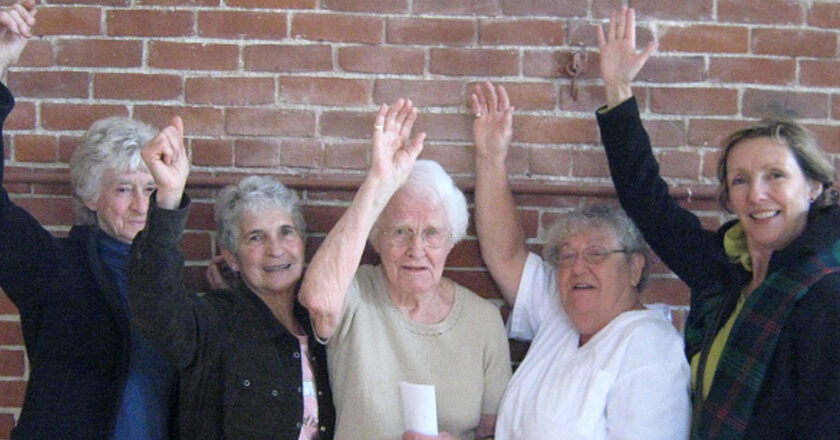
The Viactive group in Bury in 2011, showing (left to right) June Morrison, Irma Chapman, Theresa MacLeod, Judy Statton, and Martha Levesque.

“I really don’t like to be in the limelight!”
Irma Chapman really, really means that.
Irma comes in a petite package, full of energy and willingness to do whatever needs to be done. Can I say she is somewhere around 85? That for the past four years or so, she volunteered as a caregiver for a good neighbour, even during the pandemic.
“I was getting meds and groceries, doing a lot of household things. If anything went wrong, I’d get an SOS. That was quite a little experience!”
I first met Irma 10 years ago, a few years after she founded the Viactive exercise group in Bury. For about a decade, she co-led the weekly group with June Morrison. As an employee of the Centre d’action bénévole du Haut-Saint-François, I was able to watch Irma at work.
She was the model of constancy, caring, and good cheer. Her enjoyment was contagious, and she reached out to every member of the group, whether English-speaking or French-speaking.
Irma Chapman has been involved in so many volunteer activities over the years, even she has difficulty remembering them all. She’s outlived some of the organizations she worked for, some of them victims of the Covid pandemic. She was secretary of the Jolly Seniors, for example, a social and support group for seniors.
She was the agricultural reporter for the Women’s Institute. Her parents were farmers and, she joked, “I grew up on a horse’s back. I always loved horses. I had a workhorse; she was a big horse, a good horse for me to ride. I rode bareback, and I’d take her to twitch logs out of the forest for my father.”
(I had to look that up. “To twitch a log” means to hitch a log to a horse and drag it out of the forest.)
Irma Coates Chapman was born near Gould Station, when it was still a village. “When I was 14 or 15, I went out to work, looking after a little girl for a family in Huntingville. I wanted to earn money to help my family.”
After that, she went to work in Sherbrooke, first at a laundry, then at a glove and hosiery factory.
“And then I got married to Dennis. Haven’t I done well all these years! It’s been 60-some years. We were married in Canterbury in the little church there.”
They kept on living and working in Sherbrooke, where she had her first baby, daughter Joanne. They moved back to Canterbury, and “along came two babies, two boys. Randy and Steven,” she said.
She waitressed at a restaurant, while tending the gas pump. “Bury was a booming place, then.”
After that, they lived in Hardwood Flat for a number of years before moving to “the old Bob Mayhew house,” across the street from the St. Paul’s Home where Irma worked as a caregiver.
“I must have been there 12 to 15 years. At the same time I had my own Home in our house. I had about six residents.”
Irma and Dennis still live in the heart of Bury. They’ve been long-time volunteers and members of the Bury Historical & Heritage Society and the Bury’s Image de Bury. Irma was a warden for the St. Paul’s Anglican church, and more lately, a volunteer for the Trinity United Church in Cookshire.
I asked if she had any advice for those of us aging after her. “Oh no. I’ll just say – I’ve had a good life, good friends, good neighbours, a good family!”
Who needs the limelight when they’ve surrounded themselves with so much grace?

Irma Chapman

Irma Chapman : Une bonne vie

« Je n’aime vraiment pas être sous les projecteurs ! »
Irma Chapman est vraiment, vraiment sincère quand elle dit cela.
Irma vient dans un petit format, pleine d’énergie et de bonne volonté pour faire tout ce qui doit être fait. Puis-je dire qu’elle a environ 85 ans ? Qu’au cours des quatre dernières années, elle a fait du bénévolat en tant qu’aidante pour un bon voisin, même pendant la pandémie.
« J’allais chercher les médicaments et l’épicerie, je faisais beaucoup de tâches ménagères. Si quelque chose tournait mal, j’aurais un S.O.S. Ça a été toute une expérience ! »
J’ai rencontré Irma pour la première fois il y a 10 ans, quelques années après qu’elle ait fondé le groupe d’exercices Viactive à Bury. Durant près d’une décennie, elle a codirigé le groupe hebdomadaire avec June Morrison. En tant qu’employée du Centre d’action bénévole du Haut-Saint-François, j’ai pu voir Irma travailler.
Elle était le modèle de constance, de bienveillance et de bonne humeur. Son plaisir était contagieux et elle a tendu la main à tous les membres du groupe, qu’ils soient anglophones ou francophones.
Irma Chapman a participé à tant d’activités bénévoles au fil des ans qu’elle a de la difficulté à se les rappeler toutes. Elle a survécu à certaines organisations pour lesquelles elle a travaillé, dont certaines ont été victimes de la pandémie de Covid. Elle a été secrétaire des Jolly Seniors, par exemple, un groupe social et de soutien pour les aînés.
Elle a été la rapporteur agricole pour le Women’s Institute. Ses parents étaient agriculteurs, et à la rigolade elle disait : « j’ai grandi sur le dos d’un cheval. J’ai toujours aimé les chevaux. J’avais un cheval de trait; c’était une grosse jument, un bon cheval à monter pour moi. J’ai monté à cru, et je l’ai amenée à sortir des billots de la forêt pour mon père. »
Irma Coates Chapman est née près de Gould Station, alors que c’était encore un village. « Quand j’avais 14-15 ans, je suis partie travailler, m’occupant d’une petite fille pour une famille à Huntingville. Je voulais gagner de l’argent pour aider ma famille. »
Après cela, elle est allée travailler à Sherbrooke, d’abord dans une blanchisserie, puis dans une usine de gants et bonneterie.
« Et puis je me suis mariée avec Dennis. N’ai-je pas bien fait ! Cela fait une soixantaine d’années. Nous nous sommes mariés à Canterbury, dans la petite église là-bas. »
Ils ont continué à vivre et à travailler à Sherbrooke, où elle a eu son premier bébé, sa fille Joanne. Ils sont retournés à Canterbury, et « sont arrivés deux bébés, deux garçons. Randy et Steven, » a-t-elle dit.
Elle était serveuse dans un restaurant, tout en s’occupant de la pompe à essence. « Bury était un endroit en plein essor, alors. »
Ils ont ensuite vécu sur Hardwood Flat pendant un certain nombre d’années avant de déménager dans « la vieille maison de Bob Mayhew », en face de la résidence St-Paul où Irma travaillait comme soignante.
« J’ai probablement été là 12-15 ans. En même temps j’avais ma propre résidence dans notre maison. J’avais environ 6 résidents ».
Irma et Dennis vivent toujours au cœur de Bury. Ils ont longtemps été bénévoles et membres de la Bury Historical & Heritage Society et de la Bury’s Image de Bury. Irma était marguillière de l’église anglicane St-Paul et, plus récemment, bénévole pour l’église Trinity United à Cookshire.
Je lui ai demandé si elle avait un conseil pour ceux d’entre nous qui vieillissons derrière elle. « Oh non. Je dirai simplement : j’ai eu une belle vie, de bons amis, de bons voisins, une bonne famille ! »
Qui a besoin des feux de la rampe quand ils se sont eux-mêmes entourés de tant de grâce ?

Rachel Garber

PILLERS

I was looking at a photo of about 20 people. It was one of those stock photos meant to show an intergenerational community – inclusive, all colours, all ages. I counted two old men, but no old ladies.
That’s odd, I thought. Then it struck me, how many of our older women we have lost in the past year or so. I was interviewing Irma Chapman by phone and looking at a photo of the Viactive group she used to lead in Bury. It was 2011, and three of the five women in the photo are no longer with us: Judy Statton; June Morrison, who co-led the group; Theresa MacLeod, nurse and matron at St. Paul’s Home when Irma worked there.
Thinking about the pandemic, Irma remarked, “There’s a lot that we’ve lost, a lot that won’t come back. A lot of activities, meetings. It just won’t be the same. We’ve lost a lot of people.” Then she mentioned June and Garth Harrison, who had been good friends and neighbours when she and Dennis used to live in Hardwood Flat. I thought of Muriel Watson, who slipped away from us last October.
The most recent losses feel the most poignant. Serena Wintle: I’d just spoken to her by phone and quoted her in my last column, published three days after she passed away. She was looking forward to resuming her Viactive group in Cookshire after the current Covid restrictions. She’d been leading it since 2012. In parting, she gave us a kind admonition: “I hope people are exercising at home!”
Serena was a consummate quilter. One very special object she quilted with Sandra Morrison pays tribute to the 15 Compton County Women’s Institutes, including the Bury branch – the last one existing in our area. The quilt is part of a website, 100objects.qahn.org, where an article Serena co-authored lays out the remarkable but unsung contributions of Women’s Institutes – the white line down the centre of highways, railway-crossing stop signs, pasteurized milk, mandatory stops for school buses, hot lunches in schools, and equality under law for women. The Institutes advocated many other life-changing measures for millions of people here, in Canada, and beyond.
The article ends with a short bio that says Serena was a secondary school teacher, and Jane Bishop recalls she taught at the Pope Memorial School in Bury, back in the days when it offered high school. Over the years, she was a lay reader in the Anglican church and a leader in many ongoing community initiatives – “messy church,” the Women’s Institute, the Guild, the seniors’ club in Bulwer. I know she had great love for her family and her community.
Behind the scenes, she quietly visited, phoned, and wrote letters to people. Jane noted that she had phoned two or three widowed friends just the day before she died. “She was just a really gracious, helpful, kind person.”
Serena MacLeod Wintle. Muriel Hammond Watson. Two pillers of our community, whose contributions were so stalwart, yet so discreet. Just like the Women’s Institutes! We profit from their legacies almost without noticing. They have now left us. Let us treasures the old ladies still among us!
JOURNALING AND WELLNESS
Townshippers’ Association invites you to a Zoom workshop in English about how journaling can benefit your mental well-being. Claire Suisman of Vent Over Tea will introduce writing techniques and exercises that incorporate basic wellness practices in an interactive hands-on workshop of writing and sharing. The workshop is aimed at beginners, but is open to all via Zoom on Thursday, January 20, from noon to 1 p.m. To register, contact Cisco at ca@townshippers.org.
BLACK HISTORIES IN THE TOWNSHIPS
In an online exhibition, the Eastern Townships Research Centre (ETRC) offers a collection of historical snapshots shedding light on important chapters in the Black history of our region, including slavery, the Underground Railroad, blackface minstrel performances, 1920s jazz, the Black activist movements of today, and more. Dr. Sunita Nigam will launch the exhibit with a presentation on Wednesday, February 2, at 7 p.m. via Zoom or on the ETRC Facebook page. For information, and to register for the Zoom, visit Black-histories.com.
DITCHING DIET CULTURE
A Zoom workshop on Ditching Diet Culture is this Wednesday, February 2, at 12 to 1 p.m., facilitated by Cora Loomis, registered dietitian. The workshop will be recorded, and the video of it will be available for one month after the live session to those who register, so interested persons who cannot attend should still sign up. For the link, email Michelle at ml@townshippers.org.
INTUITIVE EATING GROUP
It’s not too late to register for the Introduction to Intuitive Eating group in English, via Zoom, led by Cora Loomis, registered dietitian. The series of five support sessions are on Mondays from March 7 to April 4, from 7 to 8:30 p.m. The $25 fee for the series includes an Arrimage Estrie membership. Register at: https://arrimageestrie.com/groupessoutien/intuitive-eating-group/.
“Each meeting will include group discussions and activities as well as personal reflections and exercises that will allow you to move slowly towards a way of eating that provides more freedom and way more enjoyment,” said Cora Loomis in the group description.
CHURCHES
Anglican. Bishop Bruce Myers continues to offer Home Prayers at 10:30 a.m. (new time!) on Sundays via Facebook, and at quebec.anglican.ca (Worship Videos). Info: 819-887-6802, or consult quebec.anglican.ca.
United. For updated worship services in February, please call the office at 819-889-2838; contact Rev. Tami Spires at 819-452-3685 (leave message) or spiresta@hotmail.com, or check the “United Eaton Valley Pastoral Charge” Facebook page.
Baptist. Regular in-persons services resume on Sunday, February 13: in French at 9 a.m., in English at 11 a.m., respecting Covid protocols, including masks, hand sanitizing, and a vaccine passport. For information, please contact Pastor Michel Houle at 819-239-8818.
Do you have news to share? Call 819-640-1340 or email rawrites@gmail.com by February 7 for publication February 16, or by February 21 for March 2.

Rachel

DIFFICULT EMOTIONS

Show me a pandemic among humans, and I’ll show you difficult emotions!
Two Zoom workshops offering skills for dealing with such feelings are planned for Wednesdays, January 19 and 26. The first workshop focuses on “in the moment” panic attacks, anger management, and other intense feelings. The second deals with “thinking ahead” – identifying underlying causes and suggesting long-term solutions and techniques. Psychotherapist Melissa Hindley will lead both workshops, and both begin at 7 p.m. To register, contact Mental Health Estrie at 819-565-2388 or outreach@mentalhealthestrie.com, or visit MHE’s Facebook page or website, mentalhealthestrie.com.
JOURNALING AND WELLNESS
Townshippers’ Association invites you to a Zoom workshop in English about how journaling can benefit your mental well-being. Claire Suisman of Vent Over Tea will introduce writing techniques and exercises that incorporate basic wellness practices in an interactive and hands-on workshop of writing and sharing. The workshop is aimed at beginners, but is open to all via Zoom on Thursday, January 20, from noon to 1 p.m. To register, contact Cisco at ca@townshippers.org.
BLACK HISTORIES IN THE EASTERN TOWNSHIPS
In an online exhibition, the Eastern Townships Research Centre (ETRC) offers a collection of historical snapshots shedding light on important chapters in the Black history of our region, including slavery, the Underground Railroad, blackface minstrel performances, 1920s jazz, the Black activist movements of today, and more.
Dr. Sunita Nigam will launch the exhibit with a presentation on Wednesday, February 2, at 7 p.m. via Zoom or on the ETRC Facebook page. For information, and to register for the Zoom, visit Black-histories.com.
DITCHING DIET CULTURE
Ditching Diet Culture, a Zoom workshop, is to be facilitated by Cora Loomis, registered dietitian, on Wednesday, February 2, at 12 to 1 p.m. The idea is to move away from “diet culture” and towards “food freedom and body acceptance.” The workshop will be recorded, and the video of it will be available for one month after the live session to those who register. So interested persons who cannot attend should still sign up, for access to the recording. For the link, email Michelle at ml@townshippers.org.
INTUITIVE EATING GROUP
Arrimage Estrie is offering an Introduction to Intuitive Eating group in English, led by Cora Loomis, registered dietitian. The series of five support sessions are on Mondays from March 7 to April 4, from 7 to 8:30 p.m., via Zoom.
Participants in will explore an approach that focuses on health and well-being without trying to control weight. Among the 10 principles of this approach are hunger and fullness cues, emotions, nutrition, movement, food beliefs, and more. “Each meeting will include group discussions and activities as well as personal reflections and exercises that will allow you to move slowly towards a way of eating that provides more freedom and way more enjoyment,” said Cora Loomis in the group description.
“It isn’t offered all that often in English,” pointed out Michelle Lepitre. “It also follows nicely on the Ditching Diet Culture workshop because intuitive eating and ditching diet culture go hand-in-hand.”
The group is filling up fast. The $25 fee for the series includes an Arrimage Estrie membership. Register at: https://arrimageestrie.com/groupessoutien/intuitive-eating-group/.
YOGA IN SAWYERVILLE
If permitted by Covid protocols, the Sawyerville yoga class is to begin Tuesday, February 1st, at 10 a.m. For confirmation, contact Myrna MacDonald Lowry via Messenger, email at myrnamac44@gmail.com, or by phone at 819-875-5393.
HUMANS AND WATER
Les yeux dans l’eau (Eyes in the Water) is an art exhibit at The Foreman Art Gallery of Bishop’s University from January 21 to March 16. The exhibit looks at human and non-human relationships with water. The Foreman Art Gallery and Sporobole Art Center, housing the exhibit, are both located at the crossings of the St-Francis, Magog, and Massawippi River. The artists are Kelly Jaclynn Andres, Maude Deslauriers, Gaëlle Elma, Tania Love, Ludovic Boney and Caroline Monnet. For information, visit the exhibition web page at foreman.ubishops.ca/les-yeux-dans-leau/. Respecting Covid health measures, the opening reception has been postponed.
BOOKS GALORE
“Tired of the TV screen? Treat yourself to a visit to our tiny town library in Sawyerville, at 11 A Clifton Road (back door). Tiny it is in appearance, but it is also huge, for it belongs to a great lending system under the umbrella of Le Réseau Biblio de l’Estrie which both provides and searches for books near and far,” wrote librarian Ann Rothfels.
The Sawyerville Library has books for children and adults, in both English and French. Opening hours are Wednesdays from 7 to 8:30 p.m. and Saturdays from 9:30 to 11:30 a.m. And yes, the library remains open, with Covid protocols in place. For information, please contact Ann Rothfels at 819-875-5428, “your friendly volunteer librarian for these past forty years.”
VIACTIVE SKIPS A BEAT
The bilingual Viactive exercise groups in Cookshire, Newport, and Sawyerville are all on hold because of Covid restrictions. “In the meantime, to keep your spirits up, go to move50plus.ca,” suggested Lyne Maisonneuve of the Newport group.
I visited that website and got my French spirits lifted nicely. After a bit of searching, I found stayonyourfeet/keeping active to lift my English spirits. “I hope people are exercising at home,” said Serena Wintle, who leads the Cookshire group.
“We’ll let you know as soon as Viactive starts up again,” said Denise Nault of the Sawyerville group.
CHURCHES
United. For updated worship services in January and February, please call the office at 819-889-2838; contact Rev. Tami Spires at 819-452-3685 (leave message) or spiresta@hotmail.com, or check the “United Eaton Valley Pastoral Charge” Facebook page.
Baptist. Services are on hold until further notice. For information, please contact Pastor Michel Houle at 819-239-8818.
Anglican. Bishop Bruce Myers continues to offer Home Prayers at 10:30 a.m. (new time!) on Sundays via Facebook, and at quebec.anglican.ca (Worship Videos). Info: 819-887-6802, or consult quebec.anglican.ca.
Do you have news to share? Call 819-640-1340 or email rawrites@gmail.com by January 24 for publication February 2, or by February 7 for February 16.

Steven Aulis

Steven Aulis Receives Important Award : 125th Anniversary of Christchurch Canterbury

Steven Aulis and his Marion Phelps Award in front of the Canterbury Centre’s Gothic doors that he re-built.

“Well, my reward is sitting right there.” Steven Aulis gestured at the Christchurch Canterbury, now the newly restored Canterbury Center, a small but elegant structure.
“It’ll be there for years after I’m gone, and I’m hoping that young people will take interest in what I’m doing. Many hands make light work. I hope it will catch on,” he said as bagpipers Matthew Fowler and Sylvain Ross played in the background.
That is Aulis’s modest explanation of how he felt about receiving the prestigious Marion Phelps Award for his extensive and expert contributions to restoring the Canterbury Center.
It was September 12 in the historical Canterbury hamlet located between Bury and Scotstown, at the corner of Victoria and Canterbury roads. Grant Myers, the president of the Quebec Anglophone Heritage Network (QAHN), had just given him the award “in recognition of outstanding long-term contributions by an individual to the preservation and promotion of Anglophone heritage in Quebec.”
The Bury Historical & Heritage Society nominated carpenter-craftsman Steven Aulis for his outstanding work over the past five years. As a volunteer with the Society’s Canterbury Committee, Aulis has been instrumental in restoring the building and transforming it into a cultural centre.
The event also marked the 125th anniversary of the Anglican church, the Christchurch Canterbury. The oft-photographed little Neo-Gothic church with distinctive flying buttresses was built of local materials in 1896. In 2015, it was deconsecrated and purchased by the Bury Society.
In the following years, said QAHN’s press release, “Aulis worked on and oversaw repairs and replacements to everything from the underpinnings of the building, to the belfry, to the stained glass windows. He even replicated authentic nineteenth century Gothic-style moldings and interior decorative scrollwork.”
“He remains committed to the preservation of what is now known as the Canterbury Center,” wrote QAHN’s executive director, Matthew Farfan, “one of the area’s finest heritage sites, now enjoying a new vocation within the community.”
For these reasons and more, QAHN selected Aulis from among all the candidates Quebec-wide to receive the Marion Phelps Award for Volunteerism.
Marion Phelps was a legendary volunteer, one of the founders of the Brome Historical Society. QAHN chooses one recipient each year to receive an award in her name.
“We nominated Steve because of his dedication to the Canterbury Centre, and his gift of time over an extended period,” said Ed Pederson, secretary of the Bury Historical & Heritage Society.
“He made the schedule for the restorations of the building. It was his idea to put louvres instead of plywood in the bell tower windows, and he created them. He rebuilt the cross atop the 55-foot-high tower, and also reconstructed the Gothic-style front doors by hand from old floorboards. He repaired many of the buttresses. He built new frames for the stained glass windows when they were restored. He also installed new mouldings where the exterior mouldings were rotten, and he built window casings and put the windows in.”
“When we moved the building, he repaired and, where necessary, reproduced the decorative latticework,” continued Pederson. “He adapted the benches to fit against the walls and made necessary repairs. He acquired chairs and restored all the wooden chairs, which involved gluing 30 chairs and repairing them. He helped with the landscaping as well, and painted the floor twice inside. He’s been there every step of the way!”
“I think Steve Aulis highly deserves the Marion Phelps Award. It’s an appropriate, timely recognition of his character and his community spirit.”
Those who know Aulis also know that he achieved this incredible work despite enormous physical challenges. He broke his neck in a fall in 1986, in a local mill, and is paraplegic as a result. His trademark plaid shirt and pair of long walking staffs are a familiar sight around Bury.
At the award ceremony and anniversary celebration, a 125th Anniversary Plaque was unveiled, honouring those who contributed in some way to the restoration of the building over the last 5 years. The president of the Bury Historical & Heritage Society, Praxède Levesque Lapointe, officiated as the names of 75 Canterbury Center volunteers were read out. Following the ceremonies, volunteers rang the Canterbury bell 125 times.
The Canterbury Committee members working with Aulis are Candy Coleman, Gilles Gaulin, Bobby Jacklin, Tony de Melo and Ed Pederson.
QAHN “could not have come up with a more compelling recipient for this year’s Phelps Award,” said Myers. Because of the tireless work of volunteers like Steven, important historic sites like Canterbury Church will continue to serve as community landmarks, as places of memory, and as gathering places for years to come. It is volunteers like you who are the very backbone of grassroots heritage organizations that are working so hard to preserve and protect our heritage.”

ACTU-Rachel

THIS TOO

“Year 2020 was better than you think,” says Facebook. “Kinda late,” I think.
Let’s do a reality check, and in the meantime see how 2021 compared, and what we can look forward to in 2022. Yes, Happy New Year!
First, the Facebook post says, in 2020, “the ozone hole over Antarctica closed.”
Why does ozone matter? From down under, the government of Australia (awe.gov.au) explains the ozone in the stratosphere about 15 to 30 kilometres above the Earth “covers the entire planet and protects life on earth by absorbing harmful ultraviolet-B (UV-B) radiation from the sun.” Chemically active forms of chlorine and bromine produced by humans causes its thinning.
Reality check: Every year since the 1970s, this hole been opening in early fall and closing again by year-end. The Earthobservatory.nasa.gov/ reports the 2021 hole is similar to the one in 2020, larger than average. It grew to roughly the size of North America before starting to shrink in mid-October. Why so big? Because of unusually cold temperatures and strong winds in the stratosphere above Antartica.
The good news: Thanks to the Montreal Protocol on Substances that Deplete the Ozone Layer, the ozone hole over the South Pole is now substantially smaller than in the early 2000s. The Protocol is an environmental agreement banning the release of harmful ozone-depleting chemicals, called CFCs, or chlorofluorocarbons. To this day, this is the only UN treaty ever ratified by every country on Earth.
Sigh. The simplistic list of 15 ways 2020 was “better than you think” would take too many words to factcheck. The list was an attempt, I think, to help us feel better about the pandemic.
Two years wiser, we are absorbing the lightening strike of the omicron variant of the novel coronavirus. By now we’ve been through several variants, several waves of infections. The worldometers.info says the world has seen more than 272 million cases of Covid-19, resulting in more than 5 million deaths.
The past century has been characterized as the “pandemic era.” Can we admit the truth of this era, “an elaborate dance” between the virus descendants of the 1918 influenza and the human immune responses? These two partners, “remain linked and in step, even as each strives to take the lead.” Those are the words of Anthony Fauci and two other researchers in a 2009 article in the New England Journal of Medicine. Covid-19 was foreseeable, and foreseen.
Remember the early days of 2020 when we all said “Ça va bien aller”? We thought the pandemic would be over in a matter of weeks. Truth is, it was magical thinking. It would have been more truthful to say “cela va passer” but we do not really know when, how, or what will come next.
An old Sufi fable says a king asked his advisor for something that, when he was sad, would make him happy, and when he was happy, would make him sad.
The next day, his advisor presented him with a beautiful ring. The king had been depressed for days, but now, when he looked at the inscription on the ring, he began to laugh out loud. He read, “This too shall pass.”
In later years, it happened that his kingdom was under fierce attack. Alone on his horse, he fled for his life, but was cornered. Looking down at his ring, he read “This too shall pass,” and so died in peace.
The world is complicated. All will pass, but the hard truth is that endings are not always happy. We can only do what is possible, on a daily basis, without predicting the results. So much is within our control, collectively, if we can only work together to save our world.
But it is complicated. There’s the environment, there are so many species hurtling toward extinction, there are wars, starvation, illness, and ignorance. There are desperate refugees, and more of them are climate refugees than any other kind. There is global warming. Persons of good will who care about those around us are in high demand these days! Without even mentioning the baby steps of washing hands, masking, distancing, and vaccinating.
I remind myself: Together we are mending the ozone hole! But it is complicated. A fun allegory of this is on YouTube: Just search for “this too shall pass Ok Go,” and watch the music video showing the Rube Goldberg Machine. Enjoy, and Happy New Year!
JOURNALING AND WELLNESS
How can journaling benefit your mental well-being? Townshippers’ Association invites you to a Zoom workshop in English about the benefits and barriers of writing. Claire Suisman of Vent Over Tea will introduce writing techniques and exercises that incorporate basic wellness practices in an interactive and hands-on workshop of writing and sharing. The workshop is aimed at beginners, but is open to all. Just bring a pen and paper to your computer screen on Thursday, January 20, from noon to 1 p.m. To register, contact Cisco at ca@townshippers.org.
CHURCHES
Baptist. In-person Sunday services are with Covid-19 protocols in place (distancing; masks can be removed when sitting down; wear masks when singing, etc.). Persons with flu symptoms are asked not to attend services. Services are in Sawyerville, in French at 9 a.m. and in English at 11 a.m. The pastor’s message is also available on YouTube: For the link, contact Pastor Michel Houle at 819-239-8818.
Anglican. Bishop Bruce Myers continues to offer Home Prayers at 4 p.m., Sundays, on Facebook, and at quebec.anglican.ca (Worship Videos). Info: 819-887-6802, or consult quebec.anglican.ca.
United. In-person Sunday services are bi-weekly (with vaccine passport, masks), beginning January 16 at 9:30 a.m. in the basement of Victoria Hall, 125 Principale W., Cookshire, and Sawyerville United, 11 a.m. Info: 819-452-3685 (leave message); spiresta@hotmail.com; or United Eaton Valley Pastoral Charge (Facebook).
Do you have news to share? Call 819-640-1340 or email rawrites@gmail.com by January 10 for publication January 19, and by January 24 for February 2.

Steven Aulis

Steven Aulis Receives Important Award : 125th Anniversary of Christchurch Canterbury

Steven Aulis and his Marion Phelps Award in front of the Canterbury Centre’s Gothic doors that he re-built.

“Well, my reward is sitting right there.” Steven Aulis gestured at the Christchurch Canterbury, now the newly restored Canterbury Center, a small but elegant structure.
“It’ll be there for years after I’m gone, and I’m hoping that young people will take interest in what I’m doing. Many hands make light work. I hope it will catch on,” he said as bagpipers Matthew Fowler and Sylvain Ross played in the background.
That is Aulis’s modest explanation of how he felt about receiving the prestigious Marion Phelps Award for his extensive and expert contributions to restoring the Canterbury Center.
It was September 12 in the historical Canterbury hamlet located between Bury and Scotstown, at the corner of Victoria and Canterbury roads. Grant Myers, the president of the Quebec Anglophone Heritage Network (QAHN), had just given him the award “in recognition of outstanding long-term contributions by an individual to the preservation and promotion of Anglophone heritage in Quebec.”
The Bury Historical & Heritage Society nominated carpenter-craftsman Steven Aulis for his outstanding work over the past five years. As a volunteer with the Society’s Canterbury Committee, Aulis has been instrumental in restoring the building and transforming it into a cultural centre.
The event also marked the 125th anniversary of the Anglican church, the Christchurch Canterbury. The oft-photographed little Neo-Gothic church with distinctive flying buttresses was built of local materials in 1896. In 2015, it was deconsecrated and purchased by the Bury Society.
In the following years, said QAHN’s press release, “Aulis worked on and oversaw repairs and replacements to everything from the underpinnings of the building, to the belfry, to the stained glass windows. He even replicated authentic nineteenth century Gothic-style moldings and interior decorative scrollwork.”
“He remains committed to the preservation of what is now known as the Canterbury Center,” wrote QAHN’s executive director, Matthew Farfan, “one of the area’s finest heritage sites, now enjoying a new vocation within the community.”
For these reasons and more, QAHN selected Aulis from among all the candidates Quebec-wide to receive the Marion Phelps Award for Volunteerism.
Marion Phelps was a legendary volunteer, one of the founders of the Brome Historical Society. QAHN chooses one recipient each year to receive an award in her name.
“We nominated Steve because of his dedication to the Canterbury Centre, and his gift of time over an extended period,” said Ed Pederson, secretary of the Bury Historical & Heritage Society.
“He made the schedule for the restorations of the building. It was his idea to put louvres instead of plywood in the bell tower windows, and he created them. He rebuilt the cross atop the 55-foot-high tower, and also reconstructed the Gothic-style front doors by hand from old floorboards. He repaired many of the buttresses. He built new frames for the stained glass windows when they were restored. He also installed new mouldings where the exterior mouldings were rotten, and he built window casings and put the windows in.”
“When we moved the building, he repaired and, where necessary, reproduced the decorative latticework,” continued Pederson. “He adapted the benches to fit against the walls and made necessary repairs. He acquired chairs and restored all the wooden chairs, which involved gluing 30 chairs and repairing them. He helped with the landscaping as well, and painted the floor twice inside. He’s been there every step of the way!”
“I think Steve Aulis highly deserves the Marion Phelps Award. It’s an appropriate, timely recognition of his character and his community spirit.”
Those who know Aulis also know that he achieved this incredible work despite enormous physical challenges. He broke his neck in a fall in 1986, in a local mill, and is paraplegic as a result. His trademark plaid shirt and pair of long walking staffs are a familiar sight around Bury.
At the award ceremony and anniversary celebration, a 125th Anniversary Plaque was unveiled, honouring those who contributed in some way to the restoration of the building over the last 5 years. The president of the Bury Historical & Heritage Society, Praxède Levesque Lapointe, officiated as the names of 75 Canterbury Center volunteers were read out. Following the ceremonies, volunteers rang the Canterbury bell 125 times.
The Canterbury Committee members working with Aulis are Candy Coleman, Gilles Gaulin, Bobby Jacklin, Tony de Melo and Ed Pederson.
QAHN “could not have come up with a more compelling recipient for this year’s Phelps Award,” said Myers. Because of the tireless work of volunteers like Steven, important historic sites like Canterbury Church will continue to serve as community landmarks, as places of memory, and as gathering places for years to come. It is volunteers like you who are the very backbone of grassroots heritage organizations that are working so hard to preserve and protect our heritage.”

Steven Aulis

Steven Aulis décroche un prix d’envergure : 125e anniversaire de Christchurch Canterbury

Steven Aulis et son prix Marion Phelps devant les portes gothiques du Canterbury Centre qu’il a reconstruites.

« Eh bien, ma récompense repose juste là. » Steven Aulis faisant un geste vers le Christchurch Canterbury, le Centre Canterbury récemment restauré, une structure petite, mais élégante.
« Ce sera là pendant des années après mon départ, et j’espère que les jeunes s’intéresseront à ce que je fais. Lorsque plusieurs mettent la main à la pâte, c’est plus facile. J’espère que ça va devenir populaire », a-t-il déclaré tandis que les cornemuseurs Matthew Fowler et Sylvain Ross jouaient en arrière-fond.
Voilà l’explication modeste de M. Aulis à propos de ce qu’il a ressenti à l’idée de recevoir le prestigieux prix Marion Phelps attribué pour son expertise et ses vastes contributions à la restauration du Centre Canterbury.
C’était le 12 septembre dans le hameau historique de Canterbury situé entre Bury et Scotstown, au coin des chemins Victoria et Canterbury. Le président du Réseau du patrimoine anglophone du Québec (RPAQ), M. Grant Myers, venait de lui remettre le prix « en reconnaissance des contributions exceptionnelles d’une personne ayant oeuvré à long terme à la préservation et à la promotion du patrimoine anglophone au Québec. »
La Société d’histoire et du patrimoine de Bury a nommé l’artisan charpentier Steven Aulis pour son travail exceptionnel au cours des cinq dernières années. À titre de bénévole auprès du Comité de Canterbury de la Société, M. Aulis a joué un rôle déterminant dans la restauration du bâtiment et dans sa transformation en centre culturel.
L’événement marquait également le 125e anniversaire de l’église anglicane Christchurch Canterbury. Souvent photographiée, la petite église néo-gothique avec des arcs-boutants distinctifs a été construite avec des matériaux locaux en 1896. En 2015, elle a été désacralisée et achetée par la Société Bury.
Le communiqué de presse du RPAQ fait mention qu’au cours des années qui ont suivi, « M. Aulis a travaillé et supervisé toutes les réparations et les modifications qui ont eu lieu, des fondations du bâtiment au beffroi en passant par les vitraux. Il a même reproduit d’authentiques moulures de style gothique du XIXe siècle et des volutes décoratives intérieures. »
« Il demeure impliqué dans la préservation de ce qui est maintenant connu sous le nom de Centre Canterbury », écrivait le directeur exécutif du RPAQ, Matthew Farfan : « l’un des plus beaux sites patrimoniaux de la région, jouissant désormais d’une nouvelle vocation au sein de la communauté. »
Pour ces raisons et plus encore, parmi tous les candidats à l’échelle du Québec, le RPAQ a sélectionné M. Aulis pour recevoir le Prix Marion Phelps pour le bénévolat.
Marion Phelps était une bénévole légendaire, l’une des fondatrices de la Société historique du comté de Brome. Le RPAQ choisit un récipiendaire chaque année pour recevoir un prix en son nom.
« Nous avons nommé Steve en raison de son dévouement au Centre de Canterbury et du don de son temps tout au cours d’une longue période », a déclaré Ed Pederson, secrétaire de la Société d’histoire et du patrimoine de Bury.
« Il a fait l’agenda des restaurations du bâtiment. C’était son idée de mettre des persiennes au lieu du contreplaqué aux fenêtres du clocher, et il les a créées. Il a reconstruit la croix au sommet de la tour de 55 pieds de haut, et a également reconstruit les portes d’entrée de style gothique travaillées à la main à partir de vieux planchers.
« Il a réparé de nombreux contreforts. Il a construit de nouveaux cadres pour les vitraux lorsque ceux-ci ont été restaurés. Il a aussi installé de nouvelles moulures là où les moulures extérieures étaient pourries et il a construit des encadrements de fenestration et y installa les fenêtres. 
« Lorsque nous avons déplacé le bâtiment, il a réparé et, où c’était nécessaire, il a reproduit le treillis décoratif », a poursuivi M. Pederson. « Il a adapté les bancs pour qu’ils s’ajustent aux murs et a effectué les réparations requises. Il a acquis des chaises et restauré toutes les chaises en bois, ce qui a impliqué le collage de 30 chaises et leur réparation. Il a également aidé à l’aménagement paysager et à deux reprises, il a peint le plancher à l’intérieur. Il a été là à chaque étape du chemin! »
« Je pense que Steve Aulis mérite grandement le prix Marion Phelps. C’est une reconnaissance appropriée, qui arrive en temps opportun, de sa personnalité et de son esprit communautaire. »
Ceux qui connaissent M. Aulis savent aussi qu’il a réalisé ce travail incroyable malgré d’énormes défis physiques. Il s’est fracturé le cou lors d’une chute en 1986, dans un moulin local et est devenu paraplégique. Sa chemise à carreaux caractéristique et sa paire de longs bâtons de marche font partie du paysage familier dans les environs de Bury.
Lors de la cérémonie de remise des prix et de la célébration marquant le 125e anniversaire, une plaque commémorative a été dévoilée honorant ceux qui ont contribué d’une manière ou d’une autre à la restauration du bâtiment au cours des 5 dernières années. La présidente de la Société d’histoire et du patrimoine de Bury, Praxède Lévesque Lapointe, officiait l’événement où avait lieu la lecture des noms des 75 bénévoles du Centre Canterbury. Après la cérémonie, des bénévoles ont sonné 125 fois la cloche de Canterbury.
Les membres du Comité de Canterbury travaillant avec M. Aulis sont Candy Coleman, Gilles Gaulin, Bobby Jacklin, Tony de Melo et Ed Pederson.
Le RPAQ « n’aurait pas pu trouver un récipiendaire plus irrésistible pour le prix Phelps de cette année », a déclaré M. Myers. « Grâce au travail inlassable de bénévoles tel que Steven, des sites historiques importants comme l’église de Canterbury continueront de servir de repères communautaires, de lieux de mémoire, et en tant qu’endroits de rassemblement pour les années à venir. Ce sont des bénévoles comme vous qui sont l’épine dorsale des organisations patrimoniales locales qui travaillent si fort pour préserver et protéger notre patrimoine. »

©2026 Journal Le Haut-Saint-François